Key takeaways
- Pressure delivery over raw temperature: Flat mops rely on contact and dwell; pressurized canisters push steam sideways into the grout channel. If your lines are recessed or textured, a canister with a detail nozzle does in one pass what a flat head needs six for.
- Where the mass sits: Weight low and forward over the head reduces the wrist torque you feel at the end of a stroke. A heavy handle-mounted tank turns every scrub into a lever exercise. Grip the unit in-store or check the head-to-handle balance before committing.
- Continuous steam versus a trigger: Squeeze triggers are fine for spot work, punishing across a whole bathroom. Look for a locking trigger or variable dial so your index finger isn’t the limiting factor on a 40-minute job.
- Serviceable wear parts: The first things to fail are pad hook-and-loop, gaskets, and the swivel joint. Prioritize models with sold-separately pads, replaceable seals, and a metal-reinforced swivel over one-piece plastic assemblies.
- Cord length and tank capacity as ergonomic specs: A 23-foot cord and a mid-size tank mean fewer trips to the outlet and sink. Every interruption is a chance to set the hot head on a surface it shouldn’t touch.
What's inside
Grout is a sponge with a hard face. It sits a millimeter or two below the tile plane, which means every pass of a flat mop head skims over the very channel holding the grime. That geometry is the real problem buyers run into: the floor looks clean, the lines still read gray, and the instinct is to lean harder on the handle. Two rooms later your lower back and forearm are paying for a job the tool should have done with heat and dwell time instead of body weight.
This guide looks at steam mops through an ergonomics-and-durability lens rather than a spec-sheet one. Where does load sit on your wrist during a scrubbing stroke? Which parts wear out first, and can you replace them? How long can you actually work before a refill, a cord relocation, or a hand cramp breaks your rhythm? Below are the models worth considering in 2026, followed by the buying criteria I use when a floor has more linear feet of grout than it has tile.
As an Amazon Associate we earn from qualifying purchases.


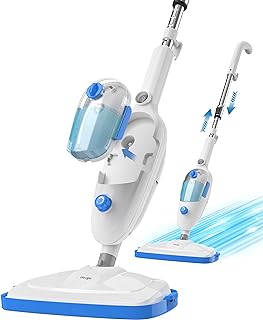


How to Choose a Steam Mop For Grout And Tile (2026)
- Pressure delivery over raw temperature: Flat mops rely on contact and dwell; pressurized canisters push steam sideways into the grout channel. If your lines are recessed or textured, a canister with a detail nozzle does in one pass what a flat head needs six for.
- Where the mass sits: Weight low and forward over the head reduces the wrist torque you feel at the end of a stroke. A heavy handle-mounted tank turns every scrub into a lever exercise. Grip the unit in-store or check the head-to-handle balance before committing.
- Continuous steam versus a trigger: Squeeze triggers are fine for spot work, punishing across a whole bathroom. Look for a locking trigger or variable dial so your index finger isn’t the limiting factor on a 40-minute job.
- Serviceable wear parts: The first things to fail are pad hook-and-loop, gaskets, and the swivel joint. Prioritize models with sold-separately pads, replaceable seals, and a metal-reinforced swivel over one-piece plastic assemblies.
- Cord length and tank capacity as ergonomic specs: A 23-foot cord and a mid-size tank mean fewer trips to the outlet and sink. Every interruption is a chance to set the hot head on a surface it shouldn’t touch.
The Best Steam Mop For Grout And Tile (2026)s Reviewed
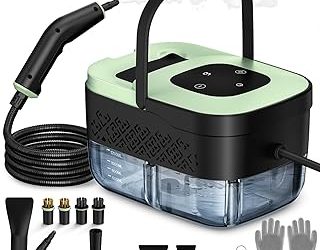
McCulloch MC1385 Canister Steam Cleaner
The canister layout is the ergonomic winner for grout: the boiler stays on the floor while you steer a lightweight wand, so your arm carries a hose instead of a water tank. Twenty-three accessories, a genuinely long duty cycle, and metal-bodied brass jets make this the durability pick for anyone treating grout as a recurring project rather than a one-off.
BISSELL PowerFresh 1940A
The Easy Scrubber flip-down tab lets you work a stubborn seam without dropping to your knees, and variable steam means you can dial back on sealed grout that doesn’t need full output. A 12-inch path and mature parts availability make it the most sensible mainstream choice; the trade-off is a flat head that needs slow, deliberate passes on deeply recessed lines.
H2O X5 5-in-1 Steam Mop & Handheld
Detaching the pod into a handheld unit is the feature that saves your back, letting you address baseboard corners and shower thresholds at hand height with a dedicated grout tool. It’s light and quick to heat, though the compact tank means planning your refills around room boundaries.
10-in-1 Detachable Steam Mop with 11 Accessories
A generous accessory kit and a detachable handheld body cover the odd angles most flat mops can’t reach, from tub surrounds to entry tile. Balance is good thanks to a low-mounted tank; inspect the swivel joint on arrival, since that’s the component that shows wear first on units in this class.
10-in-1 Multi Purpose Steamer with Adjustable Steam & Height
Adjustable handle height is an underrated durability feature for your own body, not just the machine, letting taller users work upright instead of hunching. The 23-foot cord and 15-ounce tank keep sessions uninterrupted, and two washable pads mean you’re not scrubbing with a loaded pad halfway through.
Frequently Asked Questions
Will steam damage my grout or sealant?
Cured cement grout handles steam well. Penetrating sealers tolerate it; topical film sealers can cloud or lift with repeated high-heat contact. If your grout was sealed with a glossy topical product, test one square foot and keep the nozzle moving.
Do I still need a brush?
Yes, for anything beyond light soil. Steam softens the bond; a nylon detail brush removes it. Skipping the brush is what leads people to overwork the mop and put strain on both the swivel and their shoulder.
How often should pads be replaced?
Microfiber pads lose loft after roughly 40 to 60 wash cycles, and worn hook-and-loop is the usual culprit behind pads slipping mid-stroke. Rotate three pads rather than washing one repeatedly.
Is distilled water necessary?
It’s the cheapest life extension available. Mineral scale is the leading cause of failed heating elements and clogged jets, and in hard-water regions it can halve a unit’s service life.
Final Thoughts
For serious grout work, the McCulloch MC1385 is the tool that respects both your joints and its own service life, keeping mass on the floor and giving you real pressure at the seam. The BISSELL PowerFresh 1940A is the balanced everyday choice with the best parts support, while the H2O X5 earns its place for anyone who needs to reach thresholds and corners without kneeling.