Key takeaways
- Steam delivery, not just temperature: A 248°F reading on the box means little if the vapour disperses across a 12-inch pad. Look for a machine that can concentrate output through a narrow jet or a bristled detail nozzle, which is what actually lifts residue out of a grout channel.
- Head geometry and swivel travel: A stiff swivel forces your forearm to rotate the whole shaft. Test the head at full lateral extension: if it binds before 90 degrees, you’ll be lifting and repositioning constantly, which is where wrist strain accumulates.
- Where the mass sits: Upright mops carry the tank high on the shaft, so a full reservoir raises the centre of gravity and makes the unit feel top-heavy on turns. Canister designs park the weight on the floor and leave you holding only a hose, which is far easier over long sessions but adds a trailing unit to manage.
- Refill cadence versus tank size: A 350ml tank on a compact unit runs about 10 minutes of continuous steam. That’s fine for one bathroom, punishing for a whole ground floor. Match capacity to your typical run rather than buying the largest tank you can find.
- Serviceability and scale resistance: Gaskets, the pump diaphragm and the boiler outlet are the usual failure points, and hard water accelerates all three. Prefer machines with accessible pad mounts, replaceable seals and a documented descaling routine over sealed-shut designs.
What's inside
Grout is a trap for anything on wheels or wide pads. It sits a millimetre or two below the tile surface, it’s porous, and it holds a film of soap scum and mineral residue that a flat mop head simply skims across. Most shoppers discover this the hard way: they buy on peak steam temperature alone, run the machine over a bathroom floor, and end up on their knees with a toothbrush anyway. The gap between “cleans tile” and “cleans grout” is mechanical, not thermal — it comes down to how the machine puts pressure into a recessed line, and whether your wrist and shoulder can hold that pressure for twenty minutes without complaint.
This guide looks at steam mops the way a durability tester would: joint geometry and swivel resistance, where the mass sits relative to your grip, tank placement and refill cycles, and which components are the first to fail after a year of hard water. We’ve focused on models that hold up to repeat detail work on tile and grout rather than machines optimised for a quick pass over sealed hardwood. Product links below are affiliate links.
As an Amazon Associate we earn from qualifying purchases.




How to Choose a Steam Mop For Tiles And Grout (2026)
- Steam delivery, not just temperature: A 248°F reading on the box means little if the vapour disperses across a 12-inch pad. Look for a machine that can concentrate output through a narrow jet or a bristled detail nozzle, which is what actually lifts residue out of a grout channel.
- Head geometry and swivel travel: A stiff swivel forces your forearm to rotate the whole shaft. Test the head at full lateral extension: if it binds before 90 degrees, you’ll be lifting and repositioning constantly, which is where wrist strain accumulates.
- Where the mass sits: Upright mops carry the tank high on the shaft, so a full reservoir raises the centre of gravity and makes the unit feel top-heavy on turns. Canister designs park the weight on the floor and leave you holding only a hose, which is far easier over long sessions but adds a trailing unit to manage.
- Refill cadence versus tank size: A 350ml tank on a compact unit runs about 10 minutes of continuous steam. That’s fine for one bathroom, punishing for a whole ground floor. Match capacity to your typical run rather than buying the largest tank you can find.
- Serviceability and scale resistance: Gaskets, the pump diaphragm and the boiler outlet are the usual failure points, and hard water accelerates all three. Prefer machines with accessible pad mounts, replaceable seals and a documented descaling routine over sealed-shut designs.
The Best Steam Mops For Tiles And Grout (2026) Reviewed
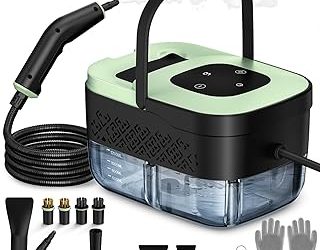
McCulloch MC1385 Canister Steam Cleaner
The canister layout is the ergonomic answer for grout work: the weight and the boiler stay on the floor while you direct a lightweight wand, so extended detail passes along baseboards and shower thresholds don’t load your shoulder. With 23 accessories including stiff detail brushes, it’s the most capable option here for genuine grout restoration rather than surface refreshing.
BISSELL PowerFresh 1940A Steam Mop
The flip-down scrubber is the detail worth paying for — it lets you apply localised pressure to a grout line without swapping tools or crouching. Variable steam control and a 12-inch path make it a sensible all-rounder, though the upright tank does sit high and you’ll feel that on tight turns around a toilet base.
Shark Steam & Scrub S8001
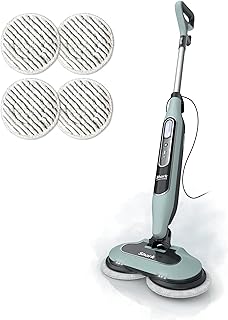
Shark’s rotating Dirt Grip pads do the agitation your arm would otherwise supply, which makes this the least fatiguing upright in the group for large tiled areas. The XL tank cuts refill trips and the LED headlights are genuinely useful for spotting residue in low-light bathrooms; the trade-off is that soft pads are less effective in deeply recessed grout than a bristle brush.
FEPPO Detachable Steam Mop & Handheld
The 15-second heat-up and detachable handheld make this the practical choice for spot work — grab the pod for a shower floor, reattach for the room. Build is lighter-duty than the McCulloch, so treat it as a maintenance tool rather than a machine for stripping years of buildup.
10-in-1 Detachable Steam Mop (248°F, 2-Level Control)
A compact, low-commitment entry point with a 10-second heat-up and two steam levels, useful if you’re cleaning one or two tiled rooms. The 350ml tank means frequent refills, and the swivel head has noticeably more play than the premium units, but the handheld mode covers grout, grill grates and car trim capably.
Frequently Asked Questions
Will steam damage my grout or its sealer?
Cured cement grout handles steam without issue. Sealers are the variable — repeated high-temperature passes will gradually wear penetrating sealers, so plan on resealing every couple of years if you steam weekly.
How often should I steam tile floors?
Weekly for kitchens and entryways, fortnightly elsewhere. Steaming is not a substitute for dry sweeping first; grit dragged under a pad abrades both the pad and the tile glaze.
Do I really need a detail brush attachment?
For grout, yes. Flat pads clean the tile face and burnish the grout surface, but only bristles reach into the recess. This is the single biggest predictor of whether a machine will satisfy you on grout.
Should I use distilled water?
If your water is hard, it’s the cheapest life-extension you can buy. Scale build-up in the boiler and outlet valve is the leading cause of weak steam and premature failure in every design here.
Final Thoughts
For serious grout recovery, the McCulloch MC1385 is the pick — floor-mounted weight, a real brush kit, and the endurance to work a whole tiled floor without loading your arms. If you want an upright that minimises effort over large areas, the Shark S8001 is the most ergonomically forgiving, and the BISSELL PowerFresh 1940A sits neatly between the two with its flip-down scrubber and variable steam.