Key takeaways
- Airflow efficiency over raw CFM: Divide CFM by watts. A DC fan moving 7,000 CFM on 35 watts is doing real work; one hitting the same figure on 90 watts is spinning fast to compensate for weak blade pitch, and that speed is what you hear all night.
- Blade span matched to mounting height: Large spans need vertical room to develop a column of air. Keep blades at least 8 to 10 inches below the ceiling and 7 feet above the floor, and treat anything over 84 inches as a 12-foot-ceiling proposition rather than a residential one.
- Motor duty rating and bearing quality: Sealed, permanently lubricated bearings and a motor rated for continuous operation are what separate a five-year fan from a fifteen-year one. Reversible DC motors also reduce start-up torque stress on the mount.
- Control ergonomics: Six discrete speeds with tactile remote buttons beat stepless dials you cannot feel in the dark. App control is genuinely useful on high mounts where a dead remote battery means hauling out a ladder.
- Environment rating and finish integrity: Damp-rated housings, powder-coated aluminum blades, and stainless fasteners resist the flex-and-corrode cycle that kills patio and garage installs. Aluminum blades also refuse to warp the way MDF veneer does in humidity.
What's inside
Airflow claims on ceiling fan boxes have become a numbers arms race, and buyers pay for it twice. First at checkout, when a five-figure CFM rating turns out to be measured at a top speed nobody can tolerate for more than ten minutes. Then again months later, when the blade holders develop a shimmy, the pull chain snaps, or the downrod hum becomes the sound you associate with summer. A fan is one of the few appliances in a house that runs for thousands of continuous hours directly above your head, which makes it a durability problem and a human-comfort problem long before it is a decorating decision.
This guide looks at high-CFM fans the way a service technician does: bearing load, blade rigidity, mounting geometry, control reach, and how the whole assembly behaves in year three rather than week one. Six current models are covered, from 120-inch shop sweeps down to a 52-inch bedroom fan, with notes on where each one earns its keep and where the engineering compromises sit.
As an Amazon Associate we earn from qualifying purchases.

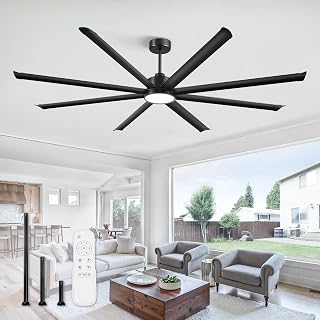


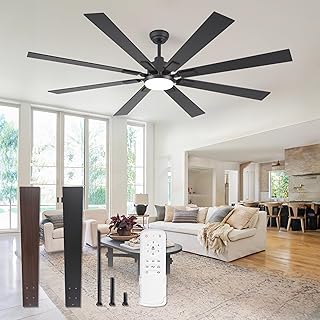

How to Choose a High Cfm Ceiling Fan (2026)
- Airflow efficiency over raw CFM: Divide CFM by watts. A DC fan moving 7,000 CFM on 35 watts is doing real work; one hitting the same figure on 90 watts is spinning fast to compensate for weak blade pitch, and that speed is what you hear all night.
- Blade span matched to mounting height: Large spans need vertical room to develop a column of air. Keep blades at least 8 to 10 inches below the ceiling and 7 feet above the floor, and treat anything over 84 inches as a 12-foot-ceiling proposition rather than a residential one.
- Motor duty rating and bearing quality: Sealed, permanently lubricated bearings and a motor rated for continuous operation are what separate a five-year fan from a fifteen-year one. Reversible DC motors also reduce start-up torque stress on the mount.
- Control ergonomics: Six discrete speeds with tactile remote buttons beat stepless dials you cannot feel in the dark. App control is genuinely useful on high mounts where a dead remote battery means hauling out a ladder.
- Environment rating and finish integrity: Damp-rated housings, powder-coated aluminum blades, and stainless fasteners resist the flex-and-corrode cycle that kills patio and garage installs. Aluminum blades also refuse to warp the way MDF veneer does in humidity.
The Best High Cfm Ceiling Fan (2026)s Reviewed
120-Inch Extra Large Industrial Ceiling Fan
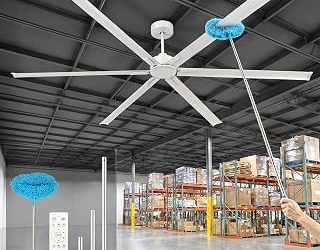
Six heavy-gauge silver aluminum blades on a ten-foot sweep move enormous volumes of air at low RPM, which is exactly the right trade for a shop or covered patio where noise fatigue accumulates over a full workday. The three included downrods matter more than they sound: correct drop length is the single biggest factor in eliminating wobble on a span this large.
ZMISHIBO 96-Inch Ceiling Fan with Lights
Eight reversible aluminum blades plus a damp-rated, industrial-grade DC motor make this the most complete large-format option here, and the 3CCT lighting saves you from adding fixtures to a high bay. Six speeds give enough low-end resolution to run it as a gentle winter destratifier rather than an all-or-nothing blower.
60-Inch 7400+ CFM Ceiling Fan
Three deeply pitched blades and a genuinely quiet DC motor deliver shop-grade throughput at a span that fits ordinary living rooms and patios. The timer and 3CCT light are practical additions, though three-blade designs are less forgiving of mounting imprecision, so verify your electrical box is fan-rated and torque the canopy properly.
Ohniyou 96″ Industrial Ceiling Fan
A no-light, eight-blade metal fan built for warehouses and gyms, with app control that removes the ladder problem when a remote goes missing. It is the most maintenance-friendly unit in this group, since there is no lighting assembly or diffuser to service at height.
ZMISHIBO 72″ Ceiling Fan with Lights
The sweet spot for large covered outdoor rooms and open-plan living areas, pairing powerful airflow with a 24W 3CCT LED and dual-finish blades that read as furniture rather than equipment. Damp-rated construction plus a quiet DC motor makes it a reasonable indoor-outdoor standard if you want one fan family throughout.
Frequently Asked Questions
How much CFM do I actually need?
Roughly 4,000 to 5,000 CFM suits a standard bedroom, 6,000 to 8,000 a large living room, and anything above 15,000 belongs in a garage, shop, or covered patio. Oversizing then running at speed two is quieter and gentler on the motor than undersizing and running flat out.
Are DC motors genuinely quieter?
Yes, and the reason is mechanical rather than marketing. DC motors avoid the 60 Hz electrical hum of AC induction motors and use smoother speed ramping, which reduces both audible noise and the start-up jolt transmitted into the mounting bracket.
Can I hang one of these on my existing electrical box?
Only if it is a listed fan-rated box secured to structure, and even then most 72-inch-plus fans exceed what a standard box is designed to carry. Large industrial spans should be through-bolted to a joist or a rated brace with the manufacturer’s downrod hardware.
Does a longer downrod improve performance?
It improves airflow and stability up to a point by giving blades room to draw air from above. Beyond about 24 inches on wide spans, lateral sway becomes the greater risk, so pick the shortest rod that still clears the 8-to-10-inch minimum.
Final Thoughts
For shops, garages, and deep covered patios, the 120-inch industrial fan and the Ohniyou 96″ are the durability picks, both built around low-RPM aluminum blade sets that stay quiet under continuous load. If you want high airflow without the industrial look, the ZMISHIBO 72″ handles large living spaces and outdoor rooms with better finish quality, while the 60-inch 7400+ CFM model is the most practical high-output choice for standard ceiling heights.