Key takeaways
- Swivel range: a true articulating joint, as on the Shark Steam & Scrub S8001, lets you steer with finger pressure rather than shoulder rotation around chair legs and toe kicks.
- Cord length: the 11-in-1 model’s 23-foot cord covers most rooms without an outlet change, and every avoided plug swap is one less crouch.
- Handle height: the grip should reach between your navel and sternum. Anything lower puts you into a sustained forward lean.
- Trigger style: continuous or lock-on steam beats a squeeze trigger if you have any thumb or wrist sensitivity.
What's inside
Laminate is a layered product, and that layering is the whole story. Under the printed decor film and wear layer sits a high-density fiberboard core that behaves like a sponge with ambitions. Get moisture into a seam and the core swells from the inside out, lifting board edges into ridges you can feel underfoot within days. Nothing sands that out. So when we talk about the “best” steam mop for laminate, we are really talking about a tool that delivers heat with the least possible liquid, dries almost as fast as it wets, and does not tempt you into lingering in one spot.
The second half of the story is the body holding the handle. A mop that torques your wrist on every turn, or forces you to stoop because the shaft is short, gets used badly or not at all. Below, you will learn how to read steam output specs, which pad and tank features actually extend a machine’s service life, how to judge weight distribution before you buy, and how to match a model to your floor plan. We have flagged a few solid options first, then explained the reasoning so you can judge any model on the shelf.
Our Recommended Picks
As an Amazon Associate we earn from qualifying purchases.




Confirm Your Laminate Can Take Steam At All
Start with paperwork, not products. Many laminate manufacturers restrict or void warranty coverage for steam cleaning, particularly on older click-lock planks without a factory-applied edge seal. Check the installation guide or the brand’s care page for your specific collection. If the floor is watertight-rated (some newer waterproof-core laminates are) you have real latitude. If it is standard HDF with a glued or unsealed seam, treat steam as an occasional sanitizing pass rather than a weekly routine, and keep an eye on high-traffic seams near entries and sinks where wear layers thin out first.
Variable Steam Is the Single Most Important Control
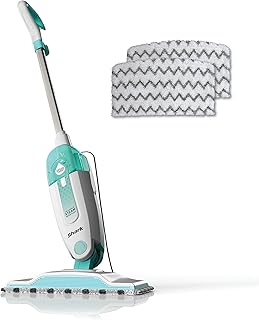
A fixed-output mop gives you one dose whether you are hitting a kitchen spill or a bedroom hallway. On laminate you want the lowest setting that still lifts soil, which is why the BISSELL PowerFresh 1940A earns its long-standing reputation: three selectable steam levels plus a 12-inch head means fewer passes at lower moisture. The Shark S1000 takes a different route, pairing a modest, steady output with pads engineered to hold moisture in the fabric instead of releasing it onto the surface. Both approaches work. What does not work is maximum steam plus a slow pass.
Read the Ergonomics Before You Read the Marketing
Weight matters far less than where that weight sits. A mop with the boiler and tank low on the body pivots easily; a top-heavy design makes your forearm do stabilizing work for the entire session.
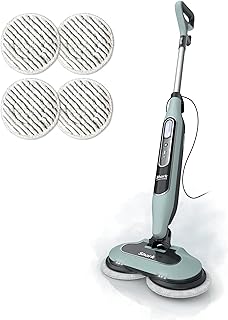
- Swivel range: a true articulating joint, as on the Shark Steam & Scrub S8001, lets you steer with finger pressure rather than shoulder rotation around chair legs and toe kicks.
- Cord length: the 11-in-1 model’s 23-foot cord covers most rooms without an outlet change, and every avoided plug swap is one less crouch.
- Handle height: the grip should reach between your navel and sternum. Anything lower puts you into a sustained forward lean.
- Trigger style: continuous or lock-on steam beats a squeeze trigger if you have any thumb or wrist sensitivity.
Pads, Tanks, and What Actually Wears Out
Steam mops rarely die from steam. They die from scale in the heating element and from cracked plastic at the tank fitting. A removable tank, like the one on the S1000, means you refill at the sink with filtered water instead of dragging the whole unit over, which spares both your back and the housing. On pads, count how many ship in the box and confirm they are machine washable. The S8001 includes four soft scrub pads, and rotating pads mid-session is the cheapest way to avoid pushing gray water around. Look for dense microfiber with a defined pile; thin flat pads glaze over and start smearing after a dozen washes.
Match the Machine to Your Actual Floor Plan
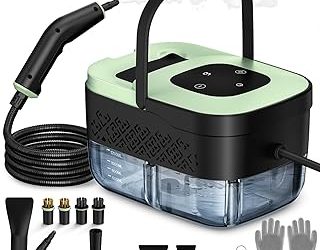
Compact homes with mixed surfaces are the natural habitat for detachable systems. The 10-in-1 unit heats in roughly ten seconds from a 350ml tank and splits into a handheld for grout, glass, and car interiors, so it earns storage space beyond floor duty. Households with pets often prefer the multi-purpose floor steamer with handheld attachments, since chemical-free sanitizing suits homes where paws and hands land on the floor. For large open-plan spaces, prioritize a wide head, an XL tank, and LED headlights, which is precisely the S8001 brief. Buying more machine than your square footage needs usually means buying more weight than your wrists want.
Tips
- Dry-vacuum first. Steam turns loose grit into abrasive slurry that scratches the wear layer.
- Keep the head moving at a steady walking pace and never park it on a seam or transition strip.
- Use distilled or filtered water to slow mineral buildup, and run a descaling cycle if your manual permits one.
- Empty the tank and hang the pad to dry after every use; trapped moisture breeds odor and warps seals.
Frequently Asked Questions
Is steam mopping safe on laminate flooring?
On sealed, tight-seamed laminate, yes, with low steam and continuous movement. On unsealed or aging planks, use it sparingly and check your manufacturer’s warranty language first.
How often should I steam my laminate floors?
Every two to four weeks is plenty for most homes. Handle routine dirt with a dry mop and a lightly dampened microfiber pad in between.
Can I add cleaning solution to the tank?
Only if the manual explicitly allows a branded additive. Detergents in the boiler leave residue, clog jets, and shorten heating element life.
Why does my floor look streaky after steaming?
Almost always a saturated pad. Swap to a clean one, drop the steam level, and skip pre-wetting the pad if your model heats from dry.
Conclusion
The right steam mop for laminate is the one that gives you the most control over the least moisture while staying comfortable in your hands for the full twenty minutes it takes to do a floor. Verify your flooring’s tolerance, favor variable steam and removable tanks, judge balance rather than raw weight, and keep spare pads in rotation. Do that, and a steam mop becomes a tool that protects your floors for years instead of quietly aging them.