Key takeaways
- Freezer position vs. your spine: Top freezers put fresh food at waist and chest height, which suits anyone who cooks daily and dislikes crouching. Bottom freezers reverse that logic — better if you raid the freezer weekly and the crisper hourly. Match the layout to whichever compartment you open most.
- Door swing and handle geometry: Measure the arc, not just the cabinet width. A reversible door is worth more than an extra cubic foot in a galley kitchen, and recessed pocket handles let you open a fridge with a forearm when both hands are full — a small ergonomic win that repeats thousands of times.
- Defrost method and long-term reliability: Frost-free (auto-defrost) systems remove the chore of chipping ice but add a heater, timer, and drain that can clog. Manual-defrost compacts have fewer parts to fail. Either is fine; know which maintenance burden you are accepting.
- Shelf load and adjustability: Check whether shelves are tempered glass on full-width supports or wire on stamped brackets. Glass on rails handles a stockpot without sagging and wipes clean; poorly supported wire shelves deflect and rattle. Adjustable spacing beats raw capacity every time.
- Ambient temperature rating: Garage and basement placement kills compressors not rated for wide temperature swings. If the unit will live outside conditioned space, confirm the operating range before anything else.
What's inside
An icemaker is the single most failure-prone component in a modern refrigerator. It routes a water line into a cold cabinet, adds a solenoid valve, a fill tube, a motorized ejector, and a bin that steals the top third of your freezer. When any of that leaks or jams, you are not fixing a fridge anymore — you are troubleshooting plumbing inside an appliance. Buyers who have already lived through one warped floorboard or one seized auger tend to arrive at the same conclusion: skip the ice.
This guide looks at fridges without icemakers through two lenses that matter over a ten-year ownership window: ergonomics — how much bending, reaching, and door-swing clearance the layout demands of you daily — and durability, meaning fewer wet components, simpler defrost logic, and gaskets and hinges built to survive thousands of cycles. Below are six units spanning garage-ready full-size models, apartment-scale bottom freezers, and genuinely quiet compact options, with the trade-offs stated plainly.
As an Amazon Associate we earn from qualifying purchases.


How to Choose a/an Fridge Without Ice Maker (2026)
- Freezer position vs. your spine: Top freezers put fresh food at waist and chest height, which suits anyone who cooks daily and dislikes crouching. Bottom freezers reverse that logic — better if you raid the freezer weekly and the crisper hourly. Match the layout to whichever compartment you open most.
- Door swing and handle geometry: Measure the arc, not just the cabinet width. A reversible door is worth more than an extra cubic foot in a galley kitchen, and recessed pocket handles let you open a fridge with a forearm when both hands are full — a small ergonomic win that repeats thousands of times.
- Defrost method and long-term reliability: Frost-free (auto-defrost) systems remove the chore of chipping ice but add a heater, timer, and drain that can clog. Manual-defrost compacts have fewer parts to fail. Either is fine; know which maintenance burden you are accepting.
- Shelf load and adjustability: Check whether shelves are tempered glass on full-width supports or wire on stamped brackets. Glass on rails handles a stockpot without sagging and wipes clean; poorly supported wire shelves deflect and rattle. Adjustable spacing beats raw capacity every time.
- Ambient temperature rating: Garage and basement placement kills compressors not rated for wide temperature swings. If the unit will live outside conditioned space, confirm the operating range before anything else.
The Best Fridge Without Ice Maker (2026)s Reviewed
KoolMore 28-Inch 14 Cu. Ft. Top Freezer
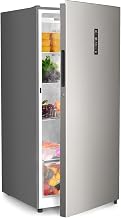
A deliberately plain stainless box in a 28-inch footprint, built to tolerate garage and utility-room duty where finished-kitchen models struggle. The top-freezer layout keeps produce and leftovers at comfortable standing height, and with no water line entering the cabinet there is one fewer leak path behind the unit.
Upstreman 14.6 Cu. Ft. Frost Free Top Freezer
The strongest all-round pick here: frost-free operation, an electronic thermostat that holds temperature more steadily than a mechanical dial, ENERGY STAR certification, and a reversible door that solves awkward hinge-side clearance. Low measured noise makes it viable for open-plan kitchens where the compressor sits within earshot of the sofa.
BLACK+DECKER 16.4 Cu. Ft. Top Mount (BR1640KW)
Best capacity per dollar for family use, and the separate temperature controls matter more than the spec sheet suggests — independent fridge and freezer adjustment prevents the classic compromise of frozen lettuce or soft ice cream. Auto defrost, wide glass shelves, and a straightforward two-door build with few electronic points of failure.
Upstreman 7.1 Cu. Ft. Bottom Freezer
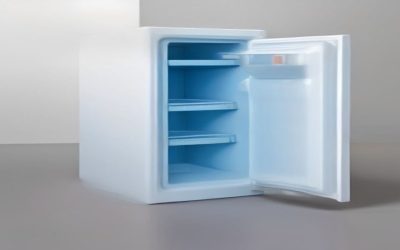
Purpose-built for apartments and in-law suites, with the freezer drawer below so the fresh-food section sits in the natural sightline rather than at knee level. Energy-efficient, quiet, and unusually well-organized for its size, with an adjustable thermostat that copes with seasonal room-temperature drift.
4.5 Cu. Ft. 2-Door Mini Fridge with Freezer
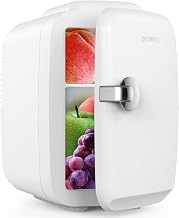
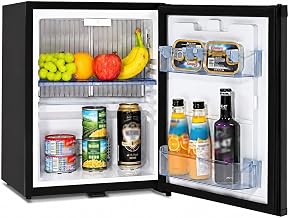
At roughly 38 dB it is quiet enough to sleep beside, which is the real specification in a dorm room or small office. A true separate freezer compartment, seven thermostat levels, and adjustable shelves make it far more usable than the single-door minis it competes with.
Frequently Asked Questions
Are refrigerators without icemakers more reliable?
Generally, yes. Removing the water valve, fill tube, ice mold, and ejector motor eliminates the components most often cited in service calls and water-damage claims. Fewer wet parts inside a cold cabinet means fewer things to freeze, jam, or drip.
How much usable space do I actually gain?
Expect roughly 20 to 30 percent more freezer volume compared with an equivalent model carrying an in-freezer ice bin, and full-width shelving instead of a bin cutout. On a top freezer, that difference is the space between fitting a frozen turkey and not.
What if I still want ice on demand?
Then buy for the dispenser rather than against it — the Sharp SJF2955KS 28.9 cu. ft. French door offers ice and water with Advanced Cooling Plus in a standard-depth 36-inch cabinet. Just budget for a properly installed shutoff valve and inspect the connection annually.
Can I add an icemaker later?
Some cabinets are pre-plumbed and accept a factory kit; most budget top freezers are not. Retrofitting an unprepared unit rarely justifies the cost or the risk. Two silicone trays and a lidded bin remain the cheapest, most durable solution.
Final Thoughts
For most kitchens the Upstreman 14.6 Cu. Ft. frost-free top freezer is the balanced choice, pairing steady electronic temperature control with a reversible door and quiet operation. Families needing more room should take the BLACK+DECKER 16.4 Cu. Ft. for its dual controls and generous shelving, while apartments and secondary spaces are best served by the Upstreman 7.1 Cu. Ft. bottom freezer, which puts everyday food where your hands already are.