Key takeaways
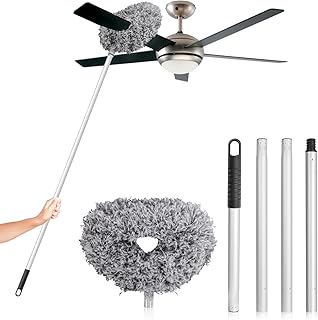
- Extend only as far as you need. A telescoping pole with a wide adjustment window, like the DRQ duster at 13 to 48 inches or the FONUNO model reaching 13 to 50 inches, lets you match the pole to the ceiling instead of always working at maximum length.
- For 10-foot-plus ceilings and stairwell fans, choose a purpose-built long reach such as the 6 ft / 72-inch extension pole duster rather than standing on furniture to make a shorter tool work.
- Grip near your sternum with your lower hand and use the upper hand for guidance. Keep your gaze mostly forward and step around the fan rather than craning to reach the far blade.
What's inside
Ceiling fan blades collect dust in a way almost nothing else in a home does. The leading edge sits in moving air for hours at a time, picking up airborne lint and cooking grease that then binds fine particulate into a felted grey layer. That layer is not just cosmetic. Uneven buildup across four or five blades shifts mass away from the hub at the point of greatest leverage, and the resulting imbalance loads the motor bearing and downrod coupling every rotation. Fans that wobble usually started out balanced.
The other half of the problem is the person doing the cleaning. Overhead work with an extended arm, a tipped-back head, and a ladder under your feet is one of the least forgiving postures in domestic maintenance, and it is the reason most fans get cleaned twice a year instead of monthly. Below is a method built around keeping both feet on the floor, keeping your shoulder below 90 degrees of flexion, and choosing tools whose microfiber and locking mechanisms survive more than a season of washing.
Our Recommended Picks
As an Amazon Associate we earn from qualifying purchases.


Understand What You Are Actually Removing
Fan dust is a composite: skin cells and textile fibers held together by a thin film of aerosolized cooking oil and, in some homes, candle or fireplace soot. That film is why dry dusting alone leaves a smeared residue on gloss-finished blades, and why a wet cloth on a raw MDF blade edge is a bad idea. The sequence that works is dry capture first, then a lightly dampened pass only on sealed or laminated surfaces. Anything with a swollen, fuzzy edge has already taken on moisture and should stay dry from then on.
Work From The Floor And Respect The Moment Arm
An extension pole solves the reach problem and creates a torque problem. A pole locked out at 48 inches puts the duster head far enough from your hands that even a few ounces of head weight becomes a noticeable wrist and shoulder load, and the flex in a fully extended tube makes precise contact harder. Practical guidance:
- Extend only as far as you need. A telescoping pole with a wide adjustment window, like the DRQ duster at 13 to 48 inches or the FONUNO model reaching 13 to 50 inches, lets you match the pole to the ceiling instead of always working at maximum length.
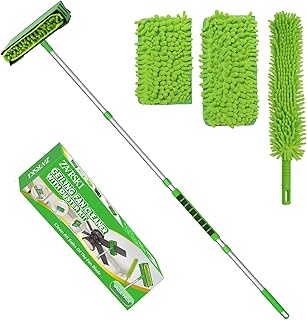
- For 10-foot-plus ceilings and stairwell fans, choose a purpose-built long reach such as the 6 ft / 72-inch extension pole duster rather than standing on furniture to make a shorter tool work.
- Grip near your sternum with your lower hand and use the upper hand for guidance. Keep your gaze mostly forward and step around the fan rather than craning to reach the far blade.
Judge The Sleeve, Not The Marketing
The pole is a commodity; the head is where durability lives. Look for a U-shaped or pincer head that wraps both blade faces at once, so one pass does the work of three. Check that the microfiber sleeve is removable and machine washable, that its seams are stitched rather than glued, and that the pile is dense enough to hold dust electrostatically instead of pushing it off the edge. The SetSail duster and the 13 to 49.7-inch reusable model are both built around this washable-sleeve pattern, which matters because a sleeve that survives 30 wash cycles is a fundamentally cheaper tool than one you replace every few months. Wash on cold with detergent only, and skip fabric softener, which coats the fibers and kills the static cling that makes microfiber work.
Sequence The Room So You Only Clean Once
Dust falls. Do the fan before floors, before furniture surfaces, and ideally with a dropped sheet under the fixture. Switch the fan off and let it stop completely, then work blade by blade from hub to tip, lifting away from the surface at the end of each stroke rather than dragging back. Shake or vacuum the sleeve outdoors between blades once it stops picking up. Finish with the motor housing and the top of the light kit, where the heaviest deposits usually sit.
Cover The Places A Pole Head Cannot Reach
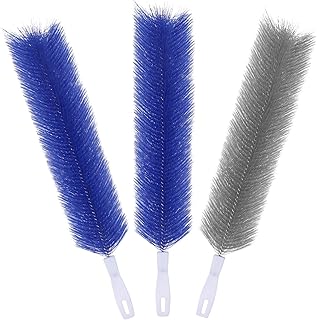
Blade arms, the recess between the housing and the downrod, and the pull-chain area all resist a rigid head. A set of bendable microfiber cobweb brushes, such as the 3-piece flexible fan cleaning brushes, bends into those gaps and doubles for return-air vents, blind slats, and car dashboards. Keeping one dedicated to greasy kitchen fixtures and one for general dusting prevents you from spreading oil film around the house.
Tips
- Clean monthly during heavy fan-use months; a light 90-second pass beats a quarterly deep clean and never lets grease-bound layers set.
- Wipe a slightly damp sleeve over sealed blades once or twice a year, then dry immediately with a second pass.
- Check blade screws at the arm and hub while you are up there. Loose hardware causes more wobble than dust does.
- Store the pole collapsed and dry. Leaving it extended keeps the locking collar under tension and shortens its life.
Frequently Asked Questions
Do I need a ladder at all?
For standard 8 to 9-foot ceilings, no. A telescoping fan duster covers that range comfortably. Ladders become sensible only for hardware inspection, glass shade removal, or ceilings above roughly 11 feet where even a 72-inch pole leaves you reaching.
Can I use a vacuum brush attachment instead?
You can, and it captures dust well, but holding a hose overhead is heavier and more awkward than a balanced pole, and the rigid attachment only contacts one blade face at a time.
Will cleaning fix a wobbling fan?
Sometimes. Remove the dust first, then retighten the blade and hub screws. If the wobble persists, the cause is usually a bent blade arm or a mismatched blade set, which needs a balancing kit rather than more cleaning.
How long do microfiber sleeves last?
A well-stitched sleeve washed cold without softener typically holds its grabbing power for a year or two of monthly use. Replace it once the pile lies flat and dust starts sliding off instead of sticking.
Conclusion
The best method here is the one you will actually repeat: a floor-level, ground-stable pass with a wraparound microfiber head sized to your ceiling, a washable sleeve you maintain properly, and a flexible brush for the awkward corners. Do that briefly and often, keep the hardware snug, and your fan stays balanced, quieter, and considerably easier on your shoulders.