Key takeaways
- Fill height and port geometry: Top-fill openings at 30 inches or higher let you pour from a standing position without a deep hip hinge. Side-access drawers near the floor force repeated squatting, which becomes the reason the unit sits dry and unused. Check that the opening is wide enough for a standard pitcher spout.
- Tank capacity versus carry weight: A 3-gallon reservoir runs longer but weighs about 25 pounds when full, so the unit needs to be filled in place. Dual-tank designs split that load into manageable halves you can carry to the sink individually.
- Caster and chassis quality: Look for four casters set at the housing’s outer corners rather than inboard, and inspect whether they are molded into the base or press-fit into thin plastic sockets. Press-fit stems in unreinforced polypropylene are the most common structural failure on these units.
- Media pad and filter serviceability: Evaporative pads mineralize and eventually harbor odor. A pad that slides out through a rear panel without tools will actually get cleaned; one buried behind the pump assembly will not. Confirm replacements are sold separately.
- Control reach and oscillation range: Panels angled toward the ceiling are readable standing but invisible from a desk chair. Pair a front-facing panel with a physical remote, and prefer wider oscillation sweeps for open-plan rooms over narrow throws that only cool one seat.
What's inside
Anyone who has wrestled a 70-pound compressor unit into a sliding window, then lived with a fat exhaust duct radiating heat back into the room, understands the appeal of a hoseless cooler. Renters with casement windows, home office workers in converted attics, and anyone whose lease forbids window modifications all land in the same place: they need airflow relief without drilling, bracketing, or hauling. The trade-off is worth naming plainly, because it shapes every recommendation below. Units marketed as “ventless portable air conditioners” are evaporative coolers. They drop the temperature of the air passing through a wet media pad, which works genuinely well in dry heat and much less so above roughly 60% relative humidity.
This guide evaluates the current crop through two lenses that spec sheets rarely address: ergonomics and durability. That means how far you bend to fill the tank, whether the fill port accepts a pitcher without spilling down the housing, how the control panel reads from a seated position, and which components fail first after two summers of daily use — pump seals, caster stems, louver hinges, and media pads. A cooler you dread refilling is a cooler you stop using by August.
As an Amazon Associate we earn from qualifying purchases.


How to Choose a Ventless Portable Air Conditioner Without Hose (2026)
- Fill height and port geometry: Top-fill openings at 30 inches or higher let you pour from a standing position without a deep hip hinge. Side-access drawers near the floor force repeated squatting, which becomes the reason the unit sits dry and unused. Check that the opening is wide enough for a standard pitcher spout.
- Tank capacity versus carry weight: A 3-gallon reservoir runs longer but weighs about 25 pounds when full, so the unit needs to be filled in place. Dual-tank designs split that load into manageable halves you can carry to the sink individually.
- Caster and chassis quality: Look for four casters set at the housing’s outer corners rather than inboard, and inspect whether they are molded into the base or press-fit into thin plastic sockets. Press-fit stems in unreinforced polypropylene are the most common structural failure on these units.
- Media pad and filter serviceability: Evaporative pads mineralize and eventually harbor odor. A pad that slides out through a rear panel without tools will actually get cleaned; one buried behind the pump assembly will not. Confirm replacements are sold separately.
- Control reach and oscillation range: Panels angled toward the ceiling are readable standing but invisible from a desk chair. Pair a front-facing panel with a physical remote, and prefer wider oscillation sweeps for open-plan rooms over narrow throws that only cool one seat.
The Best Ventless Portable Air Conditioner Without Hose (2026)s Reviewed
3-In-1 Evaporative Cooler with 4 Ice Packs (White)
A sensible baseline unit: the 70-degree sweep and 7-hour timer cover typical bedside and desk-side duty, and the included ice packs give you a short burst of noticeably colder output when the room first heats up. The compact footprint moves easily between rooms, though the shorter housing means a lower fill point than the taller models here.
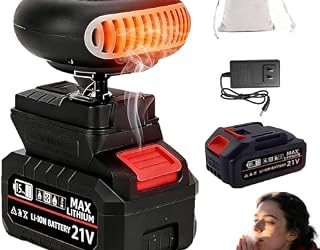
DeWalt 20V Max Compatible AC/DC Cooler
The standout for garages, workshops, and patios where outlets are scarce — running off a 20V Max pack you already own removes the cord-management problem entirely, and the 3-gallon tank supports a full day of cooling. Battery operation adds weight at the base, which helps stability, but plan to fill it where it sits rather than carrying it loaded.
24″ Ultra-Quiet 3-IN-1 with Remote
The best-balanced pick for bedrooms and small offices: 120-degree oscillation covers a seating area properly, and the low-speed noise floor stays unobtrusive enough for calls and sleep. The 2-gallon tank is the ergonomic sweet spot, heavy enough to run overnight and light enough to handle without strain.
38.6″ Tall Evaporative Cooler (Black)
Height is the ergonomic advantage here. The tall tower places the fill port and controls near waist level, eliminating the deep bend that shortens the service life of floor-level units, and the large tank plus 12-hour timer reduces refill frequency. Its narrow base benefits from being positioned away from foot traffic.
Dual-Tank 24-Hour Cooling Cooler
The two-reservoir layout is the smartest durability and handling decision in this group — you carry two light tanks instead of one unwieldy one, and continuous operation no longer depends on a single pump drawing from a low waterline. The 28-foot remote and wide oscillation make it the strongest choice for larger bedrooms.
Frequently Asked Questions
Will a ventless unit actually cool a room like a real air conditioner?
No. Evaporative coolers lower the temperature of air moving through them, typically by 8 to 15 degrees Fahrenheit at the outlet, but they add moisture and do not remove heat from the space. In dry climates the effect is substantial; in humid coastal air, expect a strong fan with mild cooling.
How often do I need to refill the tank?
Plan on once or twice daily with continuous use. A 2-gallon tank on medium speed generally runs 8 to 12 hours, while 3-gallon and dual-tank designs stretch toward a full 24 hours.
Do the included ice packs make a meaningful difference?
They help for the first 30 to 60 minutes and are best saved for peak afternoon heat. Rotating two packs through the freezer keeps the boost available without waiting on a refreeze cycle.
What maintenance keeps one running past a single season?
Empty and dry the tank when storing, rinse the media pad monthly during heavy use, and vacuum the intake filter every few weeks. Standing water left in the reservoir is the primary cause of odor and pump failure.
Final Thoughts
For most bedrooms and home offices, the 24″ ultra-quiet 3-IN-1 hits the best balance of manageable tank weight, useful oscillation, and a noise floor you can sleep through. Choose the dual-tank model if you want all-day runtime without hauling a heavy reservoir, and the DeWalt 20V-compatible unit if you need cooling in a garage or outdoor space where a cord simply is not an option.