Key takeaways
- Purity method: Look for steam-distilled or steam-purified and filtered water, not “purified,” “spring,” or “drinking” water. Only true distillation drives mineral content near zero, which is what protects wicks, nebulizers, and heating plates.
- Bottle size and pour ergonomics: A 12 to 20 oz bottle sits in one hand at a neutral wrist angle and empties in a controlled stream. Anything above a gallon forces a two-handed lift and an unstable tipping motion over an open tank.
- Cap and seam integrity: Check for leakproof threaded caps and thicker sidewalls. Bottles that ship in tight cases take compression well; flimsy ones deform, crack at the shoulder, and weep in a travel bag.
- Material and shelf stability: BPA-free PET is the standard. Sealed single-serve bottles hold indefinitely on a shelf, unlike an opened jug that collects dust and airborne particulates every time you crack the cap.
- Supply math: Count total ounces against your nightly draw. Small tabletop and bedside humidifiers typically use 8 to 16 oz per session, so a 12-pack of 12 oz bottles covers roughly two weeks of light use.
What's inside
Most humidifier complaints trace back to one decision made in about four seconds: what goes into the tank. Tap water carries dissolved calcium and magnesium, and once the machine aerosolizes it, those minerals land on your furniture as white dust and bake onto the components as scale. From a durability standpoint the damage is cumulative and quiet — wicking filters stiffen, ultrasonic membranes lose amplitude, heating elements crust over, and the unit starts running louder and outputting less while drawing the same power. Distilled water removes the mineral load entirely, which is why nearly every manufacturer specifies it and why so few owners actually use it.
The other half of the problem is handling. A two-gallon jug from the grocery aisle is heavy, top-loaded, and awkward to aim over a small tank opening, which is how you end up with water on a nightstand or a strained wrist at 11pm. Single-serve distilled bottles solve that: predictable weight, a spout you can control with one hand, and no leftover open container going stale. Below are six options worth stocking, followed by the criteria I use to judge bottle construction, pour geometry, and long-term value.
As an Amazon Associate we earn from qualifying purchases.



How to Choose a/an Water To Put In Humidifier (2026)
- Purity method: Look for steam-distilled or steam-purified and filtered water, not “purified,” “spring,” or “drinking” water. Only true distillation drives mineral content near zero, which is what protects wicks, nebulizers, and heating plates.
- Bottle size and pour ergonomics: A 12 to 20 oz bottle sits in one hand at a neutral wrist angle and empties in a controlled stream. Anything above a gallon forces a two-handed lift and an unstable tipping motion over an open tank.
- Cap and seam integrity: Check for leakproof threaded caps and thicker sidewalls. Bottles that ship in tight cases take compression well; flimsy ones deform, crack at the shoulder, and weep in a travel bag.
- Material and shelf stability: BPA-free PET is the standard. Sealed single-serve bottles hold indefinitely on a shelf, unlike an opened jug that collects dust and airborne particulates every time you crack the cap.
- Supply math: Count total ounces against your nightly draw. Small tabletop and bedside humidifiers typically use 8 to 16 oz per session, so a 12-pack of 12 oz bottles covers roughly two weeks of light use.
The Best Water To Put In Humidifier (2026)s Reviewed
Distilled Water for CPAP Machines & Humidifiers, 6-Pack 20 oz
The 20 oz format is the sweet spot for ergonomics — enough volume to fill most bedside tanks in a single pour, still light enough to control with your fingertips rather than your forearm. Steam purified and filtered, US-made, and the sturdier bottle wall holds shape after repeated handling.
Distilled Water 24-Pack, 16.9 oz Travel Bottles
Best value per ounce here, and the familiar 16.9 oz shape fits cup holders, drawer organizers, and side-table caddies without a custom spot. A 24-count case means you can keep a dozen at the nightstand and a dozen in a closet, which is how most people actually avoid backsliding to tap water.
Dura Cleanse Distilled Water, 6-Pack 20 oz
The standout is build quality: leakproof caps and a rigid body that survives packing pressure, making these the ones I’d throw in a suitcase. TSA-compliant sizing and a 12-day supply per case make it a clean travel kit for both humidifiers and sleep equipment.
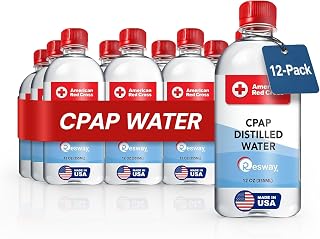
American Red Cross CPAP Distilled Water, 12-Pack 12 oz
The 12 oz bottle is the most comfortable of the group to pour one-handed, especially over a narrow tank neck or a small humidifier chamber. Twelve bottles give you flexible portioning with almost no waste if your unit takes less than a full bottle per run.
Snugell Distilled Water, 12-Pack 12 oz
Stretches to roughly 15 days of use thanks to efficient portioning, and the caps reseal reliably enough to save a partial bottle for the next night. Made in the USA, multi-use, and a sensible baseline stock for anyone running a humidifier nightly through winter.
Frequently Asked Questions
Can I just use filtered or bottled drinking water?
No. Carbon filters and most bottled waters leave dissolved minerals intact, so you still get white dust and interior scaling. Only distilled water meaningfully reduces the mineral load.
Does distilled water eliminate cleaning?
It removes scale but not biofilm. Empty and dry the tank daily and wipe it with a mild vinegar solution weekly to keep seals pliable and airflow paths clear.
Will distilled water damage my humidifier?
It won’t. Distilled water is inert toward the plastics, silicone gaskets, and metals used in consumer humidifiers, and it extends the service life of wicks and ultrasonic transducers.
Are CPAP distilled waters suitable for regular humidifiers?
Yes. CPAP-labeled bottles are simply distilled water held to a tight purity standard, which makes them ideal for any tank-fed humidifier.
Final Thoughts
For everyday household use, the 24-pack of 16.9 oz distilled bottles delivers the best cost-per-ounce without sacrificing one-handed pouring, while the 20 oz 6-pack is the most efficient refill for larger bedside tanks. If durability and travel are your priorities, the Dura Cleanse 6-pack has the strongest caps and sidewalls of the group.