Key takeaways
- Match the fuel to your power situation: Electric PTC ceramic heaters are the safer default when you’re plugged in, but 1500W consumes roughly 12.5 amps and will trip a 30-amp pedestal if your air conditioner cycles on. If you boondock, radiant propane is the only realistic option, and it demands active ventilation and a working CO alarm.
- Prioritize a low, wide base over a tall tower: Center of gravity matters more in a camper than anywhere else. Slim oscillating towers tip when the trailer rocks; low-profile boxes with a broad footprint stay planted. Tip-over shutoff is a backstop, not a substitute for stable geometry.
- Inspect the intake and exit points: Top-mounted air intakes resist the dust and pet hair that settle on camper floors, extending element life considerably. Check that the cord exits with a molded strain relief rather than a bare grommet, since flex fatigue at that joint is the most common failure I see.
- Insist on a real thermostat plus a timer: Cycling on a set temperature draws far less total energy than running continuously, which protects both your breaker and your propane supply. A 12-hour timer lets you preheat before waking without leaving a unit running unattended all night.
- Test the controls with cold hands: Recessed membrane buttons are miserable to operate at 5 a.m. in a dark camper. Look for tactile buttons, a legible display, and a remote you can actually keep in the bunk — small ergonomics that decide whether you enjoy owning the thing.
What's inside
Camper heating is a problem of constraints, not just wattage. You’re working with a shell that loses heat through thin walls and single-pane glass, a 30-amp pedestal that’s already feeding a fridge and a water heater, and floor space measured in inches rather than feet. Add the mechanical reality of a vehicle that flexes, vibrates, and gets hauled down washboard roads, and you understand why so many owners burn through two or three heaters before finding one that lasts a season. A unit that performs beautifully in a spare bedroom can rattle its ceramic element loose after 400 miles of interstate.
This guide evaluates portable heaters through a durability-and-usability lens: how the chassis handles vibration, whether the controls can be worked in the dark without crouching, how the cord exits the body, and how each design behaves when your electrical budget is tight or nonexistent. We cover both 120V electric models for shore power and radiant propane units for dry camping, with candid notes on where each one earns its keep and where it doesn’t.
As an Amazon Associate we earn from qualifying purchases.



How to Choose a Space Heater For Camper (2026)
- Match the fuel to your power situation: Electric PTC ceramic heaters are the safer default when you’re plugged in, but 1500W consumes roughly 12.5 amps and will trip a 30-amp pedestal if your air conditioner cycles on. If you boondock, radiant propane is the only realistic option, and it demands active ventilation and a working CO alarm.
- Prioritize a low, wide base over a tall tower: Center of gravity matters more in a camper than anywhere else. Slim oscillating towers tip when the trailer rocks; low-profile boxes with a broad footprint stay planted. Tip-over shutoff is a backstop, not a substitute for stable geometry.
- Inspect the intake and exit points: Top-mounted air intakes resist the dust and pet hair that settle on camper floors, extending element life considerably. Check that the cord exits with a molded strain relief rather than a bare grommet, since flex fatigue at that joint is the most common failure I see.
- Insist on a real thermostat plus a timer: Cycling on a set temperature draws far less total energy than running continuously, which protects both your breaker and your propane supply. A 12-hour timer lets you preheat before waking without leaving a unit running unattended all night.
- Test the controls with cold hands: Recessed membrane buttons are miserable to operate at 5 a.m. in a dark camper. Look for tactile buttons, a legible display, and a remote you can actually keep in the bunk — small ergonomics that decide whether you enjoy owning the thing.
The Best Space Heater For Camper (2026)s Reviewed
Xtreme Heaters Boat Cabin RV Heater
Purpose-built for marine and RV enclosures, this is the most structurally honest unit here: a squat sealed housing, a top-air intake that stays clear of floor debris, and a 6-foot cord with proper strain relief. The 750/1500W split, tip-over shutoff, and overheat protection make it the one I’d trust running unattended in a bay or storage compartment.
Mr. Heater 9,000 BTU Portable Buddy
The benchmark for off-grid warmth, delivering genuine radiant heat that warms bodies and surfaces rather than just stirring air. The fold-down handle and wire guard survive real abuse, though the 4,000/9,000 BTU output demands a cracked vent and a functioning CO detector every single time.
DREO Space Heater with Thermostat
The best-executed electric option for a well-insulated travel trailer, with 70-degree oscillation, five modes, and a thermostat that holds setpoint quietly enough to sleep beside. Its taller profile means it belongs on the floor against a wall, never on a dinette table in transit.
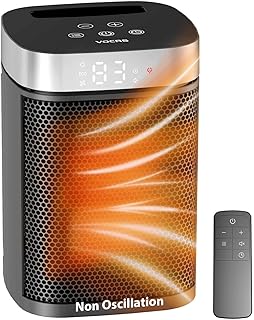
VOCRS 1500W PTC Electric Heater
A compact, sensibly weighted PTC unit whose ECO and fan modes make it a genuine three-season tool rather than a winter-only appliance. The remote and 12-hour timer are the practical highlights, and the modest footprint fits beside a wardrobe without becoming a shin hazard.
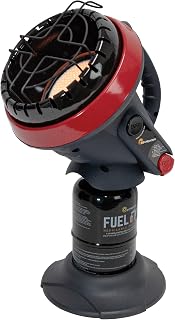
Mr. Heater 3,800 BTU Little Buddy
The right answer for truck campers and teardrops where the Portable Buddy is simply too much heat for the volume. Its one-pound cylinder mount and low-slung base resist tipping well, but treat the four-to-five-hour runtime as a supplement rather than an overnight solution.
Frequently Asked Questions
Can I safely run a propane heater overnight in a camper?
No. Even oxygen-depletion-sensor-equipped heaters should not run unattended while sleeping in a small enclosed space. Use propane for evening warm-up, then switch to an electric unit or extra bedding once you turn in.
Will a 1500W heater trip my 30-amp shore power?
It can, once the air conditioner, microwave, or water heater draws simultaneously. Run at 750W or use a thermostat-driven ECO mode to keep headroom, and stagger high-draw appliances.
Which lasts longer, electric or propane?
Well-sealed electric units generally outlive lightweight towers because there’s less to shake loose, though propane heaters like the Buddy series have very few electronic components to fail. Failures usually trace back to dust ingestion or cord fatigue.
Do oscillating models help in a camper?
Modestly. In a narrow interior, oscillation mainly prevents hot spots on nearby cabinetry, which is worth having, but a fixed heater pointed down the aisle distributes heat almost as effectively.
Final Thoughts
For plugged-in reliability that tolerates vibration, dust, and years of seasonal storage, the Xtreme Heaters RV unit remains the durability pick, with the DREO thermostat model as the more refined cabin companion for well-insulated trailers. When you’re off-grid, the Mr. Heater Portable Buddy is still the standard, provided you pair it with deliberate ventilation and a carbon monoxide alarm you’ve actually tested.