Key takeaways
- Footprint geometry over raw output: Measure your actual clear floor before shopping. A low, wide base sitting under a dinette bench beats a tall tower that occupies the only aisle in the rig. Tower designs make sense only in Class A coaches with a genuine walkway.
- Tip-over switches that survive road vibration: Mechanical pendulum switches degrade when bounced for thousands of miles. Look for weighted or magnetic-reed sensors, and test the switch by hand every few months — a stuck-closed switch is a silent failure of your primary safety feature.
- Two-stage wattage as a load-management tool: A 750W setting is not a compromise, it is a necessity. It lets you run the heater alongside a coffee maker on a 30-amp hookup and reduces thermal cycling stress on the element, which extends service life measurably.
- Control ergonomics for cold hands and dim light: Recessed touch panels are miserable to operate at 5 a.m. in a dark bunk. Prefer physical detented dials, backlit displays, or a remote you can leave bedside. Remotes also spare you from crouching, which matters in a rig with 78-inch ceilings.
- Housing material and intake placement: Top-mounted intakes stay cleaner than side or rear grilles pressed against upholstery, and cool-touch polymer shells tolerate condensation better than bare metal. Check that the cord exits with strain relief and reaches your outlet without an extension.
What's inside
An RV interior punishes appliances in ways a house never does. Cabinets flex over expansion joints, floors sit close to uninsulated subframes, and every square foot of walkway is contested. A heater that performs beautifully in a spare bedroom can become a shin-height obstacle in a 96-inch-wide coach, or shake itself apart after four seasons of washboard gravel. Add the electrical reality of a 30-amp pedestal, where 1500 watts alone consumes half your available service, and the choice narrows fast.
This guide evaluates portable heaters through two lenses I use professionally: ergonomics, meaning how the unit fits human movement in a narrow space, and durability, meaning how its housing, tip switch, and heating element survive vibration, humidity, and repeated cold starts. Below you’ll find current models worth considering for 2026, followed by selection criteria, individual assessments, and answers to the questions that come up most often at the campground.
As an Amazon Associate we earn from qualifying purchases.




How to Choose a/an Rv Space Heater (2026)
- Footprint geometry over raw output: Measure your actual clear floor before shopping. A low, wide base sitting under a dinette bench beats a tall tower that occupies the only aisle in the rig. Tower designs make sense only in Class A coaches with a genuine walkway.
- Tip-over switches that survive road vibration: Mechanical pendulum switches degrade when bounced for thousands of miles. Look for weighted or magnetic-reed sensors, and test the switch by hand every few months — a stuck-closed switch is a silent failure of your primary safety feature.
- Two-stage wattage as a load-management tool: A 750W setting is not a compromise, it is a necessity. It lets you run the heater alongside a coffee maker on a 30-amp hookup and reduces thermal cycling stress on the element, which extends service life measurably.
- Control ergonomics for cold hands and dim light: Recessed touch panels are miserable to operate at 5 a.m. in a dark bunk. Prefer physical detented dials, backlit displays, or a remote you can leave bedside. Remotes also spare you from crouching, which matters in a rig with 78-inch ceilings.
- Housing material and intake placement: Top-mounted intakes stay cleaner than side or rear grilles pressed against upholstery, and cool-touch polymer shells tolerate condensation better than bare metal. Check that the cord exits with strain relief and reaches your outlet without an extension.
The Best Rv Space Heater (2026)s Reviewed
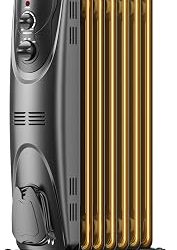
Xtreme Heaters Boat Cabin RV Space Heater
This is the only unit here engineered specifically for marine and RV duty, and it shows in the details: a squat, low-center-of-gravity base that resists tipping on a sloped site, top-air intake that won’t choke against a wall, and both 750W and 1500W settings for load management. The sealed-feeling construction and 6-foot cord suit permanent placement in a wet bay or under a bed platform where you’d rather not revisit the installation.
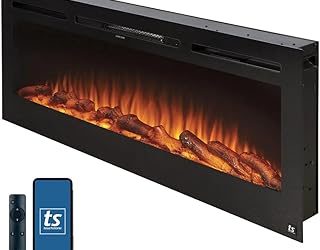
GiveBest Smart Wall Heater
Mounting a 1500W PTC unit on a wall reclaims the floor entirely, which is the single biggest ergonomic upgrade available in a small coach. Alexa integration and a 24-hour timer let you pre-warm the rig before you climb out of the bunk, though you’ll want to confirm your wall panel has real backing behind the fasteners before committing.
DREO Space Heater with Thermostat (Gold)
At a measured 34 dB, this is genuinely quiet enough to run overnight in a space where you can hear the neighbor’s slide-out. The 12-hour timer and remote make it easy to manage from a bed you can’t sit upright in, and PTC ceramic elements tolerate repeated on-off cycling better than exposed coils.
Mr. Heater Little Buddy 3,800 BTU
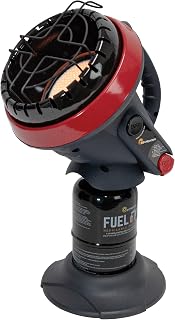
The right answer for boondocking, since it draws zero amps and runs off 1-pound propane cylinders with a stable, wide base and ODS shutoff. Treat it as a supervised daytime heater only: combustion consumes oxygen and produces moisture, so crack a vent, keep a working CO alarm, and never sleep with it burning.
DREO Oscillating Heater with 70° Sweep
Oscillation earns its keep in long, narrow floorplans where a fixed heater bakes the front and leaves the bedroom cold. ECO mode and thermostat control keep draw down once the space stabilizes, which helps on shared campground circuits.
Frequently Asked Questions
Can I run a 1500W heater on 30-amp service?
Yes, but it consumes roughly 12.5 amps, leaving limited headroom. Use the 750W setting when the air conditioner, microwave, or water heater element is active, and monitor your pedestal breaker.
Is propane safe inside an RV?
Only with active ventilation, a functioning carbon monoxide detector, and constant supervision. Unvented combustion also adds significant humidity, which encourages condensation and mold in tight interiors.
Will an electric heater keep my plumbing from freezing?
It protects interior lines but does nothing for underbelly tanks or exposed hoses. Pair cabin heat with tank heaters or heat tape in sustained sub-freezing weather.
Should I secure the heater while driving?
Always. Unplug it, let it cool, and stow it in a cabinet or strap it down. Repeated impacts are the leading cause of tip-switch and fan-bearing failure.
Final Thoughts
For most travelers, the Xtreme Heaters RV unit is the durability benchmark, built for the vibration and humidity a coach actually delivers. If floor space is your constraint, the GiveBest wall-mounted heater solves the problem outright, and the quiet DREO thermostat model remains the easiest choice for overnight comfort on hookups.