Key takeaways
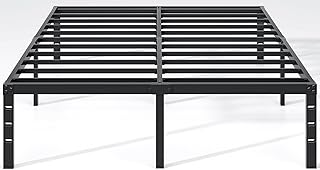
- Slat span and support geometry: Steel slats are only as good as the distance they bridge. Look for a center rail with its own legs and slat spacing under roughly 3 inches for foam or hybrid mattresses; wider gaps concentrate pressure and shorten mattress life more than they compromise the frame.
- Transfer height, not just clearance: For most adults, a mattress surface landing between 22 and 26 inches makes sit-to-stand easiest, since the knees stay near or above hip level. Work backward: an 18-inch deck plus a 12-inch mattress puts you high; a 14-inch deck suits thicker mattresses and shorter users.
- Joint design and noise control: Squeak comes from steel sliding against steel. Prefer frames with interlocking or fully bolted rail-to-leg connections rather than hook-and-slot, and check that the kit includes washers or non-slip pads at contact points.
- Load rating in context: Published capacities are static figures. Divide by two or three for a realistic dynamic margin and you’ll see why a 3,500 lb rating is reassuring rather than excessive for two adults, a 100 lb mattress, and years of movement.
- Edges, legs, and floor contact: Rounded corner legs prevent the shin bruises and torn bedding that square tube ends cause, and rubber pads protect hardwood while adding friction that keeps the frame from creeping toward a wall.
What's inside
Most metal platform frames fail in the same three places, and none of them are the places shoppers inspect. The center support takes a heavier share of load than the perimeter and starts to deflect first. Bolted joints work loose under the repeated micro-movement of sleep, which is where squeak originates. And the deck height, chosen almost at random by most buyers, quietly determines whether getting out of bed is a smooth pivot or a small daily effort on the knees and lumbar spine. A frame can hold a stated 3,500 lbs on a static test rig and still telegraph every roll-over three years in.
This guide looks at metal platform frames the way a durability engineer would: slat span and steel gauge, joint geometry and fastener retention, transfer height and edge clearance, and the small hardware details (foot pads, corner radius, mattress baffles) that decide whether a frame stays quiet and stable through a decade of use. Below are six current options, followed by selection criteria, individual assessments, and answers to the questions that come up most often after delivery.
As an Amazon Associate we earn from qualifying purchases.



How to Choose a Metal Platform Bed Frame (2026)
- Slat span and support geometry: Steel slats are only as good as the distance they bridge. Look for a center rail with its own legs and slat spacing under roughly 3 inches for foam or hybrid mattresses; wider gaps concentrate pressure and shorten mattress life more than they compromise the frame.
- Transfer height, not just clearance: For most adults, a mattress surface landing between 22 and 26 inches makes sit-to-stand easiest, since the knees stay near or above hip level. Work backward: an 18-inch deck plus a 12-inch mattress puts you high; a 14-inch deck suits thicker mattresses and shorter users.
- Joint design and noise control: Squeak comes from steel sliding against steel. Prefer frames with interlocking or fully bolted rail-to-leg connections rather than hook-and-slot, and check that the kit includes washers or non-slip pads at contact points.
- Load rating in context: Published capacities are static figures. Divide by two or three for a realistic dynamic margin and you’ll see why a 3,500 lb rating is reassuring rather than excessive for two adults, a 100 lb mattress, and years of movement.
- Edges, legs, and floor contact: Rounded corner legs prevent the shin bruises and torn bedding that square tube ends cause, and rubber pads protect hardwood while adding friction that keeps the frame from creeping toward a wall.
The Best Metal Platform Bed Frames of 2026, Reviewed
ROIL 14 Inch King Double Layer 2-in-1 Platform
The double-layer deck and six mattress baffles address the one failure mode king frames share, which is lateral mattress drift across a wide span. At 14 inches with 10 inches of usable storage below, it also lands in a comfortable transfer range for anyone pairing it with a 12-inch mattress or thicker.
FUIOBYVV Queen 18-Inch with Round Corner Legs
Rounded corner legs and non-slip contact pads make this the safer pick for tight bedrooms where you’ll be walking past the footboard in the dark. The 18-inch height maximizes underbed storage, so it pairs best with a mattress in the 8 to 10 inch range to keep the sleeping surface sensible.
Full Size 18-Inch Heavy Duty Platform
A well-proportioned option for guest rooms and single sleepers, with steel slat support and the same 3,500 lb rating found on the larger sizes, which gives a full-size deck a generous margin. Assembly is tool-light and the frame stays quiet once the center legs are seated firmly.
FUIOBYVV Queen 18-Inch with Headboard Holes
Essentially the storage-focused sibling, with pre-drilled headboard brackets that let you add a fabric or wood headboard without improvising hardware. Anchoring a headboard also reduces the small rocking motion that eventually loosens fasteners on freestanding frames.
NEW JETO Queen 14-Inch Metal Bed Frame
The most balanced dimensions here for everyday ergonomics, since 14 inches accommodates a modern 11 to 13 inch mattress and still leaves the surface easy to rise from. Storage clearance is more modest than the 18-inch models, which is the honest trade for a lower, steadier stance.
Frequently Asked Questions
Do I need a box spring with a metal platform frame?
No. Closely spaced steel slats provide a firmer, more uniform foundation than a box spring, and adding one raises the sleeping surface into an awkward range for most people.
My frame squeaks. Is it defective?
Usually not. Retorque every bolt after the first two weeks, since bedding-in of the joints is normal, and add adhesive felt at any point where two steel surfaces meet without a fastener.
Will an 18-inch frame feel too tall?
It can, particularly with a thick hybrid mattress or for shorter sleepers and anyone with hip or knee limitations. Measure your current mattress top and use that number as your target.
Are decorative iron frames as sturdy as plain platforms?
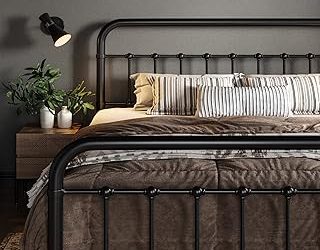
Often yes, provided the deck and center rail are the same specification. The Allewie Queen with its Victorian iron-art headboard uses a comparable steel platform beneath the ornamental panels.
Final Thoughts
For most bedrooms, the NEW JETO Queen 14-Inch hits the best compromise between transfer height and quiet stability, while the ROIL 14 Inch King Double Layer is the stronger choice for wide spans where mattress drift and center deflection matter most. If underbed storage is the priority, the FUIOBYVV Queen 18-Inch with headboard holes gives you the clearance plus a path to a properly anchored headboard.