Key takeaways
- Installation format: Confirm whether you need a countertop, over-the-range, or built-in appliance. A 24-inch built-in model requires accurate cabinet dimensions and a suitable electrical connection, while countertop units offer easier replacement and repositioning.
- Door and loading ergonomics: Drop-down doors can create a stable landing surface for hot dishes, but they need adequate clearance. Side-swing doors may be easier in tight spaces. Check handle reach, viewing angle, and whether the controls are readable without bending.
- Useful capacity: Interior volume matters less than the cavity’s shape and turntable diameter. Measure the dishes you use most, including casserole dishes, sheet pans, and air-fry baskets, rather than relying on cubic-foot numbers alone.
- Heat management: Convection and air frying add versatility, but they also produce more heat and grease than microwave cooking. Look for an accessible interior, removable accessories, and an installation location with appropriate ventilation and clearance.
- Controls and longevity: Sensor cooking, inverter power delivery, position-memory turntables, and clear displays can reduce daily frustration. Favor sturdy doors, logically grouped controls, and replaceable or easy-to-clean accessories over an excessive number of rarely used presets.
What's inside
A wall oven microwave combo with an air-fry function can simplify a kitchen, but the category is easy to misread. Some models are compact countertop appliances, while others are true 24-inch built-in units; ventilation, electrical requirements, door clearance, and usable cooking space vary considerably. A promising feature list does not always translate into a comfortable daily workflow.
This guide evaluates the strongest options for 2026 from an ergonomics-and-durability perspective. We focus on access, controls, turntable or cavity usability, cleaning, installation demands, cooking flexibility, and the practical value of convection and air-fry modes—not just wattage or the number of preset programs.
As an Amazon Associate we earn from qualifying purchases.



How to Choose a/an Wall Oven Microwave Combo With Air Fryer (2026)
- Installation format: Confirm whether you need a countertop, over-the-range, or built-in appliance. A 24-inch built-in model requires accurate cabinet dimensions and a suitable electrical connection, while countertop units offer easier replacement and repositioning.
- Door and loading ergonomics: Drop-down doors can create a stable landing surface for hot dishes, but they need adequate clearance. Side-swing doors may be easier in tight spaces. Check handle reach, viewing angle, and whether the controls are readable without bending.
- Useful capacity: Interior volume matters less than the cavity’s shape and turntable diameter. Measure the dishes you use most, including casserole dishes, sheet pans, and air-fry baskets, rather than relying on cubic-foot numbers alone.
- Heat management: Convection and air frying add versatility, but they also produce more heat and grease than microwave cooking. Look for an accessible interior, removable accessories, and an installation location with appropriate ventilation and clearance.
- Controls and longevity: Sensor cooking, inverter power delivery, position-memory turntables, and clear displays can reduce daily frustration. Favor sturdy doors, logically grouped controls, and replaceable or easy-to-clean accessories over an excessive number of rarely used presets.
The Best Wall Oven Microwave Combo With Air Fryer (2026)s Reviewed
TOSHIBA 1.0-Cu.-Ft. Air Fryer Combo Microwave
The TOSHIBA Air Fryer Combo Microwave is a sensible choice for smaller kitchens that still want convection and broiling capability. Its 12.4-inch turntable should suit everyday plates and modest baking dishes, while the relatively compact footprint makes it easier to place at a comfortable working height. The main trade-off is capacity: households regularly cooking large casseroles may find the cavity restrictive.
BLACK+DECKER 1.5-Cu.-Ft. Over-the-Range Air Fryer Microwave
BLACK+DECKER’s over-the-range model is designed to combine cooking and ventilation in one installation, making it appealing when counter space is limited. Its 300 CFM vent and six cooking modes add practical range, but over-the-range placement can be awkward for shorter users and requires careful attention to mounting height. It is best suited to kitchens where the ventilation function is as important as the air-fry feature.
AAOBOSI 24-Inch Built-In Convection Microwave
The AAOBOSI 24 Inch Built-in Microwave Convection Oven offers the proportions and integrated appearance many remodelers want, along with a drop-down door that can make loading heavier dishes more controlled. Its 1.6-cubic-foot cavity and sensor cooking support family-size meals, although built-in appliances demand precise measurements and a dependable electrical plan before purchase. The stainless-steel finish also makes fingerprints and cooking residue more visible.
KoolMore Reserve 24-Inch Built-In Air Fry Microwave
The KoolMore Reserve combines microwave, convection, and air-fry functions in a 24-inch built-in format, with a soft-close door that is particularly useful in a busy household. Its larger cavity should accommodate more substantial cookware than compact countertop models. Pay close attention to the listed NEMA 5-20P plug and your existing circuit, since electrical compatibility is a durability and safety concern—not a minor installation detail.
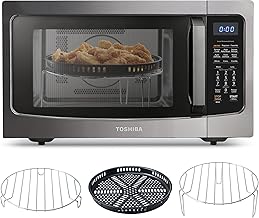
TOSHIBA 1.5-Cu.-Ft. 4-in-1 Countertop Microwave
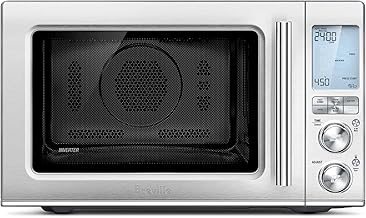
This 4-in-1 TOSHIBA model balances a generous countertop cavity with a 1,000-watt microwave, convection cooking, air frying, and smart-sensor functions. The position-memory turntable can make repeated use less annoying by returning cookware to a predictable orientation, while the mute function is useful in open-plan homes. It is a strong all-purpose option, provided you can reserve a stable, ventilated surface with enough overhead clearance.
Frequently Asked Questions
Is an air-fryer microwave the same as a wall oven?
No. A true wall oven is installed into cabinetry and generally offers a larger, dedicated baking cavity. Many “combo” products are countertop or over-the-range microwaves with convection and air-fry modes, so verify the installation type before ordering.
Can these appliances replace a full-size oven?
They can handle many everyday tasks, including reheating, roasting small portions, baking, and crisping foods. However, cavity dimensions, rack positions, and temperature recovery differ from a conventional oven, so large holiday meals may still require a full-size oven.
What is the most ergonomic installation height?
Position the controls and main cooking surface where the primary user can read, load, and remove dishes without excessive reaching or stooping. For built-in and over-the-range installations, follow the manufacturer’s clearance instructions first, then consider user height and door-swing space.
Does air frying require special maintenance?
Yes. Air frying circulates hot air and can distribute grease around the cavity. Wipe spills promptly, wash the basket or rack according to the manual, and avoid abrasive cleaners that can damage interior coatings or sensors.
Final Thoughts
The TOSHIBA 1.5-Cu.-Ft. 4-in-1 Countertop Microwave is the most broadly practical pick for flexible placement and family cooking. Choose the KoolMore Reserve for a built-in renovation with a soft-close door, or the BLACK+DECKER over-the-range model when integrated ventilation is a priority. In every case, measure the installation space, confirm the circuit, and judge capacity by your actual cookware before buying.