Key takeaways
- Cooling method: Compressor units provide more dependable temperature reduction and usually need an exhaust hose; evaporative coolers consume water and work best where the air is hot and dry.
- Room suitability: Treat BTU ratings and advertised square footage as starting points. Sun exposure, ceiling height, insulation, and open doors can reduce real-world performance.
- Moisture management: Self-evaporation reduces, but does not always eliminate, draining. In humid conditions, expect a compressor unit to produce more condensate than the marketing headline suggests.
- Ergonomics: Prioritize sturdy casters, reachable controls, a readable display, a remote, and handles that make repositioning safer. A heavy unit that is awkward to grip tends to stay in one place.
- Durability and upkeep: Look for washable filters, accessible water tanks, secure hose connections, and construction that does not flex when moved. Regular cleaning is essential for both airflow and odor control.
What's inside
Portable cooling gets confusing quickly: “self-evaporative” can describe a compressor-based air conditioner that vents collected moisture, or an evaporative cooler that uses water to temper airflow. Those designs suit different climates, rooms, and maintenance routines, so a promising specification sheet does not always translate into comfortable cooling.
This guide compares the most useful options for bedrooms, offices, and medium-size living spaces, with emphasis on ergonomics, durability, controls, tank access, noise, ventilation, and day-to-day upkeep. The goal is to help you choose a machine that is not merely powerful on paper, but practical to live with.
As an Amazon Associate we earn from qualifying purchases.


How to Choose a/an Self Evaporative Portable Air Conditioner (2026)
- Cooling method: Compressor units provide more dependable temperature reduction and usually need an exhaust hose; evaporative coolers consume water and work best where the air is hot and dry.
- Room suitability: Treat BTU ratings and advertised square footage as starting points. Sun exposure, ceiling height, insulation, and open doors can reduce real-world performance.
- Moisture management: Self-evaporation reduces, but does not always eliminate, draining. In humid conditions, expect a compressor unit to produce more condensate than the marketing headline suggests.
- Ergonomics: Prioritize sturdy casters, reachable controls, a readable display, a remote, and handles that make repositioning safer. A heavy unit that is awkward to grip tends to stay in one place.
- Durability and upkeep: Look for washable filters, accessible water tanks, secure hose connections, and construction that does not flex when moved. Regular cleaning is essential for both airflow and odor control.
The Best Self Evaporative Portable Air Conditioner (2026)s Reviewed
3000 CFM Swamp Cooler with 6.87-Gallon Tank
This high-capacity evaporative cooler is designed for extended operation, with three speeds, four modes, 120-degree oscillation, and a 15-hour timer. Its large tank reduces refill frequency, while the substantial footprint and water load make the casters and placement area especially important; it is best for dry climates rather than sealed, humid rooms.
Newair 8,000 BTU Portable Air Conditioner
The Newair is a more conventional room-cooling choice, combining compressor cooling with dehumidification, remote control, and self-evaporative operation. Its compact format is well suited to bedrooms and small rooms, though users should still plan for correct exhaust-hose installation and periodic filter cleaning.
10,000 BTU 3-in-1 Portable Air Conditioner
With cooling, dehumidifying, and fan modes, this unit targets medium rooms up to the advertised 450 square feet and includes an auto-evaporation system. The feature mix is practical for changing weather, but buyers should leave clearance around the intake and verify that the included window kit fits their window style before relying on the stated coverage.
12,000 BTU Smart Portable Air Conditioner
This is the strongest large-room candidate in the group, with stated coverage up to 600 square feet, smart controls, a sleep mode, dehumidification, and a ventilation kit. Its greater capacity can be useful in sunny rooms, but the heavier chassis and more involved setup reward a permanent placement near a suitable window.
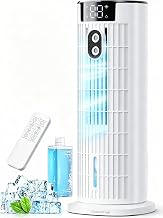
1500ML 4-in-1 Evaporative Air Cooler
Small rooms, desks, and personal cooling zones are where this compact model makes the most sense. Its 1,500-milliliter tank, USB-C power, remote, three speeds, and two mist modes offer flexible placement, although an evaporative cooler of this size should not be expected to lower an entire room like a compressor AC.
Frequently Asked Questions
What does self-evaporative mean?
In a compressor air conditioner, it generally means the unit uses warm exhaust air to evaporate some collected condensate, reducing how often you need to empty a drain pan. It does not guarantee maintenance-free operation, particularly in humid weather.
Are evaporative coolers the same as portable air conditioners?
No. Evaporative coolers add moisture to moving air and perform best in dry conditions, while compressor-based portable ACs remove heat through an exhaust hose and work across a broader range of humidity levels.
Does a portable AC need an exhaust hose?
Most compressor portable ACs do. The hose carries hot air outside; without it, the appliance can circulate air but cannot effectively remove room heat. Evaporative coolers generally do not require a window hose.
How can I make a portable unit last longer?
Clean or replace filters as directed, keep air inlets unobstructed, empty and dry reservoirs when storing the unit, and inspect hoses and window seals for damage. Move heavier models by their casters rather than pulling on the power cord or exhaust assembly.
Final Thoughts
The Newair 8,000 BTU model is the balanced pick for smaller bedrooms, while the 12,000 BTU Smart Portable Air Conditioner is better suited to larger, warmer rooms. For dry climates and personal comfort, the 3000 CFM swamp cooler offers long runtimes, whereas the compact 1500ML evaporative cooler is the more convenient desk or bedside option.