Key takeaways
- Test your preferred sleeping position with your usual pillow; the wrong pillow height can make an excellent base feel uncomfortable.
- Confirm that the base fits inside the bed frame, or plan to use the adjustable base on its own. Many traditional frames have crossbars or center rails that interfere with movement.
- Tighten leg and support hardware after the first week of use, then check it periodically for noise or looseness.
- Keep the remote, power supply, and emergency-lowering instructions accessible. Do not trap cables where moving sections can pinch them.
What's inside
The best adjustable bed is not simply the one with the most buttons. It is the base that supports your preferred sleeping posture, moves smoothly, fits your mattress, and remains dependable after years of daily use. Because an adjustable bed becomes part of your body’s nightly routine, small details—motor noise, frame flex, remote layout, leg height, and mattress compatibility—matter more than flashy specifications.
This guide takes an ergonomics-and-durability approach to choosing one. You will learn how to match positions to real comfort needs, assess construction and controls, compare useful features with gimmicks, and avoid common sizing mistakes. The recommended models inserted below cover several practical setups, from compact queen frames to split-king systems with integrated mattresses.
As an Amazon Associate we earn from qualifying purchases.

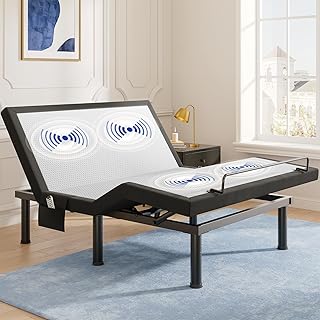


Start with the right size and configuration
Choose the sleeping surface before comparing massage modes or lighting. A queen is usually the simplest choice for one sleeper or a couple who share the same position. A split king consists of two Twin XL sections, allowing each person to raise the head or feet independently. It is usually the most flexible option for partners with different schedules, body types, or comfort preferences, although the center seam and higher cost deserve consideration.
Twin XL is useful for guest rooms, narrow bedrooms, and individually controlled sides of a larger setup. Measure the room, doorway, staircase, and elevator route—not just the area occupied by the mattress. Also account for the base’s movement: a raised head section can extend farther toward a wall or bedside table than a flat bed.
Prioritize ergonomic movement
Head and foot elevation should be smooth rather than abrupt. Look for a stable transition through the range of motion, with no sudden jolts that disturb sleep or strain a joint. Zero-gravity mode can be helpful because it distributes some load away from the lower back by raising the knees and upper body, but it is a starting position, not a medical treatment. The most comfortable angle is personal and may change with your mattress and pillow height.
For reading or television, a moderately elevated torso is often more practical than the maximum setting. A small amount of leg lift can reduce pressure behind the knees, while excessive elevation may create hip or knee discomfort. If you have persistent pain, circulation problems, or a recent injury, consult a clinician rather than treating an adjustable base as a substitute for professional advice.
Judge the frame by its daily mechanics
Durability depends on more than a published weight capacity. Inspect the frame’s center support, hinge construction, welds, upholstery, and leg attachment points. A base that feels rigid when flat should remain steady when fully raised. Excessive rocking, creaking, or side-to-side movement can indicate weak bracing or loose hardware.
Quiet motors are especially important in shared bedrooms. Listen for a smooth, consistent sound rather than focusing only on the manufacturer’s decibel claim, which may be measured under ideal conditions. A reliable wireless remote should have clearly separated buttons, tactile feedback, and simple controls for flat, zero-gravity, and memory positions. Some models, including the Tami T600 and Marsail Queen Adjustable Bed Frame, add side storage or USB ports; these are useful only if they are placed where you can reach them without bending awkwardly.
Match the mattress to the moving base
An adjustable base needs a mattress that can flex repeatedly without developing a permanent bend. All-foam and many hybrid mattresses are commonly suitable, but the exact construction matters. Very thick coils, rigid edge systems, and unusually firm mattresses may resist articulation. A mattress that is too heavy can also make the motor work harder and reduce the smoothness of movement.
Integrated packages can simplify compatibility. Options such as the Sven & Son Classic with its included hybrid mattress, the 12-inch hybrid Twin XL package, and the ESHINE Split King 14-inch hybrid package are convenient for shoppers who want a coordinated system. Check the mattress thickness, firmness, trial period, warranty, and return responsibilities separately from those of the base. A generous mattress warranty does not necessarily cover damage caused by an unsuitable adjustable frame.
Separate helpful features from distractions
Massage, under-bed lighting, USB charging, app control, and preset positions can all be convenient, but none compensates for poor support. Massage functions are generally best viewed as a relaxation feature; they should not be confused with therapeutic treatment. Under-bed lights can reduce nighttime trips and are more useful when they are dimmable or motion-sensitive rather than glaring.
Head-pillow tilt, lumbar adjustment, and independent controls may justify a higher price for someone who reads in bed or needs finer positioning. The ESHINE Split King includes several of these advanced adjustments, while the SF Split King combines a cooling gel-memory-foam mattress with lighting and USB connectivity. Consider how often you will use each feature, and prefer a simpler design if extra electronics would complicate repairs or operation.
Tips
- Test your preferred sleeping position with your usual pillow; the wrong pillow height can make an excellent base feel uncomfortable.
- Confirm that the base fits inside the bed frame, or plan to use the adjustable base on its own. Many traditional frames have crossbars or center rails that interfere with movement.
- Tighten leg and support hardware after the first week of use, then check it periodically for noise or looseness.
- Keep the remote, power supply, and emergency-lowering instructions accessible. Do not trap cables where moving sections can pinch them.
Frequently Asked Questions
Do adjustable beds work with any mattress?
No. The mattress must be designed to bend repeatedly and remain secure while elevated. Verify compatibility with both the mattress and base manufacturers, especially when using an existing mattress.
Is a split king better than a regular king?
It is better for partners who want independent head and foot positions. A regular king has a continuous surface and may feel more unified, but both sleepers share the same adjustment. Split systems can also require special sheets and may reveal a center gap.
How important is weight capacity?
It is essential, but interpret it correctly. Add the weight of sleepers, mattress, bedding, and any regular load placed on the bed. Choose a margin above that total rather than operating close to the stated limit.
Are massage and app controls worth paying for?
They are worthwhile when you will use them consistently and the underlying frame is well built. If your priority is reading, reflux-friendly positioning, or easier entry and exit, reliable elevation and a good remote should come first.
Conclusion
The best adjustable bed for 2026 is the one that combines natural positioning, quiet and stable mechanics, a compatible mattress, and controls you will actually use. Compare the complete system—not just the feature list—and give special attention to size, service terms, hardware quality, and long-term practicality. A well-matched base can make everyday rest more comfortable without turning your bedroom into a complicated piece of machinery.