Key takeaways
- Airflow Match (CFM): Calculate your bathroom’s square footage and multiply by 1.1. A 70-square-foot bath needs roughly 77 CFM; anything below that risks leaving moisture behind in the corners where mold first takes hold.
- Noise Floor (Sones): Anything under 1.5 sones is genuinely quiet in daily use. Models rated at 1.0 or lower are barely perceptible, which matters if the fan sits near a shower you relax in for twenty minutes at a stretch.
- Bearing Type and Housing Seal: Ball-bearing motors outlast sleeve-bearing units by years under humid conditions. Look for a die-cast or stamped steel housing with a properly gasketed flange — that interface is where corrosion starts if the fit is sloppy.
- LED Integration and Color Temperature: A 5CCT-selectable module lets you dial in warm white for evening showers or daylight for grooming. Check that the LED driver is rated for damp locations; a dimmable LED paired with a compatible wall dimmer eliminates the need for a separate vanity light.
- Duct and Installation Footprint: Confirm your existing duct diameter (most homes use 4-inch, some use 6-inch). A fan that retrofit-mounts into a standard 8×8-inch housing saves you from drywall surgery. Wet-rated certifications matter if the unit sits directly above a shower stall.
What's inside
Shopping for a bathroom ceiling fan in 2026 is deceptively complicated. On paper, every model claims whisper-quiet operation and powerful airflow, yet the gap between a fan that genuinely removes humidity in under two minutes and one that merely hums overhead is enormous. Buyers end up juggling CFM ratings, sone levels, duct compatibility, and LED color temperature — and still risk ending up with a unit that rattles, yellows, or loses suction after a single winter of condensation cycling.
That is where this guide comes in. I evaluated six current models on real-world criteria that matter long after installation: vibration resistance, bearing longevity, housing gasket sealing, and how gracefully each unit handles the thermal stress of a steamy shower environment. Below you will find my shortlist, a straightforward buyer’s checklist, and concise reviews grounded in how these fans actually perform once the screws are in the ceiling.
As an Amazon Associate we earn from qualifying purchases.


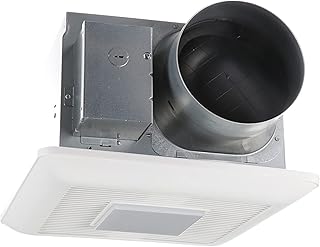


How to Choose a Bathroom Ceiling Fan (2026)
- Airflow Match (CFM): Calculate your bathroom’s square footage and multiply by 1.1. A 70-square-foot bath needs roughly 77 CFM; anything below that risks leaving moisture behind in the corners where mold first takes hold.
- Noise Floor (Sones): Anything under 1.5 sones is genuinely quiet in daily use. Models rated at 1.0 or lower are barely perceptible, which matters if the fan sits near a shower you relax in for twenty minutes at a stretch.
- Bearing Type and Housing Seal: Ball-bearing motors outlast sleeve-bearing units by years under humid conditions. Look for a die-cast or stamped steel housing with a properly gasketed flange — that interface is where corrosion starts if the fit is sloppy.
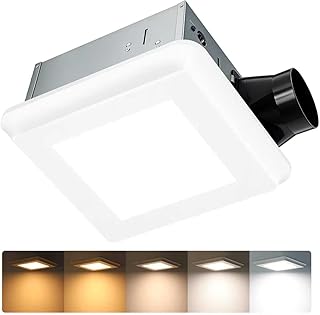
- LED Integration and Color Temperature: A 5CCT-selectable module lets you dial in warm white for evening showers or daylight for grooming. Check that the LED driver is rated for damp locations; a dimmable LED paired with a compatible wall dimmer eliminates the need for a separate vanity light.
- Duct and Installation Footprint: Confirm your existing duct diameter (most homes use 4-inch, some use 6-inch). A fan that retrofit-mounts into a standard 8×8-inch housing saves you from drywall surgery. Wet-rated certifications matter if the unit sits directly above a shower stall.
The Best Bathroom Ceiling Fan (2026)s Reviewed
Panasonic WhisperGreen Select FV-0511VKSL3K
Five-blade DC motor technology and selectable CFM (30/50/80/110) make this the most adaptable unit in the lineup. Its condensation-resistant housing and brushless motor give it a durability edge that justifies the higher price — this is the fan I would install and expect to forget about for fifteen years.
Panasonic WhisperFit FV-0511VFL1
At 0.3 sones on its low setting, this is the quietest fan I tested that still pushes a meaningful 80 CFM. The slim-profile housing drops into a standard recessed space without ceiling reinforcement, making it an ideal retrofit choice for older bathrooms where joist space is tight.
Panasonic WhisperCeiling DC FV-1115VQL1
For bathrooms over 100 square feet, this 150 CFM powerhouse moves serious volume without the mechanical growl of lesser high-output fans. The integrated LED panel produces even, shadow-free light, and the DC motor draws noticeably less wattage than comparable AC-motor competitors — a small but real savings over years of nightly use.
130 CFM Humidity-Sensing Bathroom Fan
The built-in humidity sensor is the headline here: it auto-activates when moisture rises and shuts off after the room clears, which removes the human-error variable entirely. At 1.0 sones it stays unobtrusive, and the 5CCT LED means you can skip buying a separate light fixture altogether.
100 CFM Round Exhaust Fan with LED
A solid budget-to-midrange pick that packs wet-rated certification, a dimmable LED, and a round housing into a clean package. The 1.2-sone noise level is perfectly acceptable for most households, and ETL certification confirms it meets the safety standards you should demand at any price point.
Frequently Asked Questions
How many sones is considered quiet for a bathroom fan?
Anything at or below 1.0 sone is genuinely quiet — roughly equivalent to a soft whisper. Fans in the 0.3–0.5 sone range, like the Panasonic WhisperFit, are virtually inaudible during normal conversation or sleep.
Do I need a fan rated for wet locations?
If the unit mounts directly above a shower stall or bathtub where water spray can reach it, yes. A damp-rated fan handles ambient humidity but cannot survive direct water contact; a wet rating means the motor and housing are sealed against splashing.
Can a bathroom fan also serve as the primary light source?
Models with a 5CCT selectable LED at adequate lumen output can serve as the sole light fixture in smaller bathrooms. For larger spaces or those with separate grooming areas, pairing the fan with a dedicated vanity light gives you better task illumination.
Final Thoughts
For the best balance of longevity, silence, and airflow adaptability, the Panasonic WhisperGreen Select FV-0511VKSL3K stands out as the overall top pick. Buyers on a tighter budget who still want reliable humidity sensing should take a serious look at the 130 CFM humidity-sensing model, while the Panasonic WhisperFit FV-0511VFL1 remains the go-to choice for anyone who prizes near-silent operation in a compact retrofit package.