Key takeaways
- Material and Load Path: Solid hardwood distributes weight across grain fibers more uniformly than engineered composites or thin-gauge steel tubing, meaning fewer stress concentration points that develop into squeaks or fractures over years of use. Look for beds that specify actual wood species and steel gauge rather than vague terms like “premium” or “reinforced.”
- Slat Density and Spacing: Closely spaced slats — ideally no wider than 3 inches apart — prevent mattress dipping between supports, which is the primary cause of premature foam breakdown. Metal wire grids can work, but flat wooden slats with direct-to-rail contact create a more stable, lower-vibration foundation.
- Leg Count and Placement: More legs means shorter unsupported spans and better lateral stability. A 13-leg design on a king frame, for instance, eliminates the wobble you’d feel on a 4-leg queen when sitting on the edge. Mid-frame legs are especially critical for preventing the “hammock effect” over time.
- Assembly Methodology: Tool-free and bolt-free designs reduce the chance of under-tightened connections loosening over months of use. However, if a bed uses hardware, check whether the bolts thread into metal inserts or directly into wood — metal inserts hold up to repeated disassembly far better.
- Underbed Access and Ventilation: A minimum 10-inch clearance allows meaningful underbed storage while promoting airflow beneath the mattress. Trapped moisture between a solid platform and a mattress bottom accelerates mold growth and material degradation, particularly in humid climates, so open-frame designs carry an inherent durability advantage.
What's inside
Choosing a platform bed frame looks deceptively simple until you realize that the wrong call leads to sagging mattresses, midnight creaking, or a spine that protests every morning. The market in 2026 is flooded with options that all promise “sturdy support” — yet the structural engineering behind them varies wildly, from solid hardwood slat systems with 13-leg load distribution to folded steel frames that rely on a single weld line for longevity.
This guide draws on principles of spinal alignment, material fatigue, and vibration transfer to separate genuinely well-built mattress platforms from the ones that look good in product photos. We evaluated slat spacing, load capacity, frame resonance under lateral movement, and ease of assembly — because a bed that takes two hours and a curse word to build is already failing you before you lie down.
As an Amazon Associate we earn from qualifying purchases.



How to Choose a Mattress Platform Bed (2026)
- Material and Load Path: Solid hardwood distributes weight across grain fibers more uniformly than engineered composites or thin-gauge steel tubing, meaning fewer stress concentration points that develop into squeaks or fractures over years of use. Look for beds that specify actual wood species and steel gauge rather than vague terms like “premium” or “reinforced.”
- Slat Density and Spacing: Closely spaced slats — ideally no wider than 3 inches apart — prevent mattress dipping between supports, which is the primary cause of premature foam breakdown. Metal wire grids can work, but flat wooden slats with direct-to-rail contact create a more stable, lower-vibration foundation.
- Leg Count and Placement: More legs means shorter unsupported spans and better lateral stability. A 13-leg design on a king frame, for instance, eliminates the wobble you’d feel on a 4-leg queen when sitting on the edge. Mid-frame legs are especially critical for preventing the “hammock effect” over time.
- Assembly Methodology: Tool-free and bolt-free designs reduce the chance of under-tightened connections loosening over months of use. However, if a bed uses hardware, check whether the bolts thread into metal inserts or directly into wood — metal inserts hold up to repeated disassembly far better.
- Underbed Access and Ventilation: A minimum 10-inch clearance allows meaningful underbed storage while promoting airflow beneath the mattress. Trapped moisture between a solid platform and a mattress bottom accelerates mold growth and material degradation, particularly in humid climates, so open-frame designs carry an inherent durability advantage.
The Best Mattress Platform Beds (2026) Reviewed
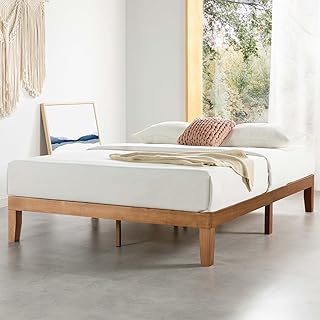
Mellow Naturalista Classic 12″ Solid Wood Platform Bed
Built from real pine with wooden slats that sit flush against the side rails, the Naturalista Classic achieves a quiet, vibration-free sleep surface that metal frames simply cannot match. The 12-inch total height strikes a practical sweet spot — high enough for easy underbed storage, low enough that getting in and out doesn’t feel like mounting a stage. Assembly is genuinely quick, and the wood-to-wood slat contact means you won’t be reaching for a screwdriver after three months to silence a developing rattle.
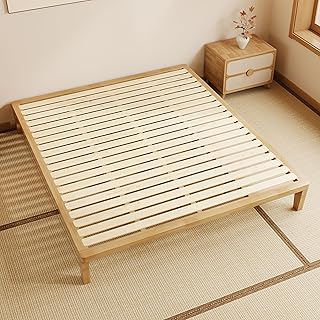
IOTXY King Solid Wood Platform Bed
The IOTXY’s 19-slat, 13-leg architecture is engineered with real structural intent — each of the three center bars shares load across nearly double the contact points of competing designs, yielding a 700-pound total capacity that feels credible rather than aspirational. The tatami-style low profile sits close to the floor, which lowers the center of gravity and makes edge-to-edge movement remarkably stable. Every component is solid pine with no particle board, a choice that pays dividends in durability at the cost of higher shipping weight.
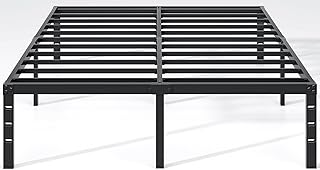
Zinus SmartBase Tool-Free Assembly Foundation
Zinus built the SmartBase on folded steel tubing with interlocking corners that snap together without tools, and the engineering tolerance on those joints is tight enough that the frame stays rigid even without a mattress’s weight holding it down. At 14 inches tall, it offers the most generous underbed storage clearance in this roundup, and the all-metal construction means zero risk of slat breakage under heavier mattresses. Noise isolation depends on proper leg placement on a flat surface — on concrete or tile, it’s silent; on older hardwood, a felt pad kit is worthwhile.
Zinus Curtis Upholstered Platform Bed
The Curtis wraps a wood-slat support system in dark grey upholstery that gives the bed a finished, furniture-grade appearance without compromising the flat-slat foundation underneath. What sets it apart ergonomically is the padded headboard and frame edges — no sharp metal corners during nighttime navigation, and a comfortable backrest when sitting up to read. Zinus’s WonderBox packaging also deserves mention: compressed components reduce shipping damage, which is a more common problem with upholstered beds than manufacturers acknowledge.
Amazon Basics Foldable Metal Platform
This frame’s strongest selling point is its folding mechanism — it collapses flat for storage or relocation and deploys in under five minutes without tools, making it the most portable option here by a wide margin. The 14-inch steel construction handles its rated load without flex, and the fully open underside maximizes ventilation beneath the mattress. Noise performance is solid thanks to rubber-capped leg feet that prevent metal-on-floor contact. For guest rooms, rentals, or anyone who moves frequently, this is hard to beat.
Frequently Asked Questions
Do I still need a box spring with a platform bed?
No. Platform beds are specifically engineered to replace the box spring by providing built-in slat or grid support. Adding a box spring on top of a platform frame actually raises the height unnecessarily and can create a springy, unstable surface that negates the frame’s structural advantages.
What is the ideal slat spacing for memory foam mattresses?
Memory foam and hybrid mattresses generally require slats no more than 3 inches apart. Wider gaps allow the foam to deform between slats, creating pressure points that accelerate wear and can void certain mattress warranties. If a frame’s slats are too widely spaced, adding plywood on top is a viable workaround.
Are metal platform beds louder than wood over time?
Not inherently — quality metal frames with tight tolerances and rubber-dampened joints can be just as quiet as wood. The noise problem arises in cheap metal frames where thin tubing flexes or where joints loosen from under-torqued hardware. Solid wood frames have an advantage in self-dampening, but a well-built steel frame will outlast most wood alternatives.
How much weight can a standard queen platform bed hold?
Most quality queen platform beds are rated between 500 and 1,000 pounds of total capacity, covering the mattress plus sleepers. Always verify whether that rating refers to static load or dynamic load — the latter accounts for movement and is the more meaningful figure. Frames with more legs and center support bars consistently outperform on dynamic load tests.
Final Thoughts
For sleepers prioritizing long-term quiet performance and natural material durability, the Mellow Naturalista Classic 12″ and the IOTXY King stand out as the most structurally sound wood options in this roundup — the IOTXY especially for its exceptional leg count and slat density on king-width frames. For those who need maximum underbed storage and zero maintenance, the Zinus SmartBase delivers steel-frame reliability at a practical price point. Every bed here avoids the box spring entirely, but their approaches to achieving that goal reflect meaningfully different engineering philosophies, so match your pick to how you actually sleep and move.