Key takeaways
- Firmness Gradient: The sleeping surface must resist indentation under minimal pressure for infants, yet offer a slight contour increase on the toddler side. Dual-sided designs handle this transition; single-sided mattresses require you to prioritize infant firmness above all.
- Core Construction: High-density polyfoam delivers predictable support at lower weight, while plant-based or innerspring cores add ventilation pathways. Avoid any core that compresses more than 15 percent under a standard load test—early sagging signals inadequate material density.
- Certifications: GREENGUARD Gold and CertiPUR-US address off-gassing compounds. OEKO-TEX Standard 100 tests finished textiles against harmful substances. These aren’t redundant; each covers a different layer of the manufacturing chain.
- Waterproofing and Washability: A removable, machine-washable cover paired with a waterproof barrier beneath extends mattress lifespan dramatically. Heat-bonded seams on the cover outlast stitched ones when subjected to repeated laundering cycles.
- Dimensional Tolerance: Standard crib interior dimensions vary slightly by manufacturer. A mattress measuring 52 × 27.6 inches with tight tolerances minimizes dangerous gaps along the edges—measure your crib before purchasing, not after.
What's inside
Choosing a crib mattress sounds straightforward until you realize how many variables actually matter: core density that supports a developing spine, edge reinforcement that won’t collapse under a toddler’s knee, cover materials that withstand repeated washing without degrading, and chemical safety certifications that aren’t just marketing theater. Most parents default to whatever fits the budget or looks popular, then discover months later that the mattress sags, traps heat, or carries a chemical odor that never fully aired out.
As someone who evaluates bedding materials through the lens of structural longevity and ergonomic soundness, I focused this guide on mattresses that balance infant-firm support with practical durability—products built to last through the crib-to-toddler transition without losing their shape or safety profile. Below you’ll find a curated shortlist plus a breakdown of the specs that actually predict real-world performance.
As an Amazon Associate we earn from qualifying purchases.


How to Choose a Crib Mattress Best (2026)
- Firmness Gradient: The sleeping surface must resist indentation under minimal pressure for infants, yet offer a slight contour increase on the toddler side. Dual-sided designs handle this transition; single-sided mattresses require you to prioritize infant firmness above all.
- Core Construction: High-density polyfoam delivers predictable support at lower weight, while plant-based or innerspring cores add ventilation pathways. Avoid any core that compresses more than 15 percent under a standard load test—early sagging signals inadequate material density.
- Certifications: GREENGUARD Gold and CertiPUR-US address off-gassing compounds. OEKO-TEX Standard 100 tests finished textiles against harmful substances. These aren’t redundant; each covers a different layer of the manufacturing chain.
- Waterproofing and Washability: A removable, machine-washable cover paired with a waterproof barrier beneath extends mattress lifespan dramatically. Heat-bonded seams on the cover outlast stitched ones when subjected to repeated laundering cycles.
- Dimensional Tolerance: Standard crib interior dimensions vary slightly by manufacturer. A mattress measuring 52 × 27.6 inches with tight tolerances minimizes dangerous gaps along the edges—measure your crib before purchasing, not after.
The Best Crib Mattress Best (2026)s Reviewed
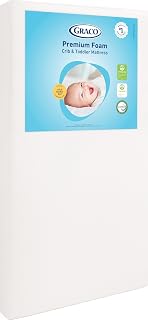
Graco Premium Foam Crib & Toddler Mattress
This mattress earns its reputation through material accountability: the GREENGUARD Gold and OEKO-TEX certifications cover both the core and the cover independently, which is rarer than you’d expect. The polyfoam core maintains firmness well beyond 18 months of daily use, and the machine-washable cover’s waterproof backing uses a TPU membrane rather than PVC—quieter, more flexible, and free of phthalate concerns. For parents who want one purchase that covers the full crib-to-toddler arc, this is the baseline I’d recommend.
Newton Baby Crib Mattress
Newton’s entire design philosophy revolves around breathability, and the Wovenaire core—a food-grade polymer mesh—delivers on that promise in a way foam simply cannot. The core is 90 percent air by volume, which means heat dissipation is structurally superior, and the entire unit is washable under a shower faucet. From a durability standpoint, the polymer mesh doesn’t compress or develop body impressions the way foam does, though the softer surface feel means you should confirm firmness meets your comfort expectations before committing.
Organic Cotton Dual-Sided 2-Stage Mattress
The two-stage design here is genuinely differentiated: the infant side uses high-resilience foam with minimal give, while the toddler side incorporates a cooling gel layer that measurably reduces surface temperature. The organic cotton cover is quilted over a waterproof membrane, and the CertiPUR-US certification confirms the foam is free of formaldehyde, heavy metals, and ozone depleters. At 5.5 inches thick, it fills the crib cavity more completely than many competitors, reducing lateral movement.
Letmxiu Premium Crib & Toddler Mattress
The knitted fabric cover with fleece surface gives this mattress a tactile quality that stands apart at its price point. The 5-inch core is a single-density foam, so there’s no dual-stage firmness switching—expect one consistent feel throughout. Hypoallergenic properties are solid, and the cover handles machine washing without pilling or shrinking. Where this mattress particularly shines is in fit: its dimensional consistency with standard crib interiors means almost zero edge gap, a genuine safety advantage.
Premium Hypoallergenic Baby Crib Mattress (52″ × 27.6″ × 5″)
This mattress takes a no-frills approach that works well for guest cribs, secondary nurseries, or families who’d rather allocate budget elsewhere. The breathable knit cover paired with a firm foam core checks every functional box without unnecessary layers. Edge support is competent if not exceptional, and the 5-inch profile sits comfortably within the standard range. It won’t win awards for innovation, but it nails the fundamentals consistently.
Frequently Asked Questions
When should I flip or rotate a crib mattress?
Dual-sided mattresses flip once—when your child transitions from infant to toddler sleep. Single-sided mattresses benefit from rotating 180 degrees every three to four months to promote even wear across the surface.
Is a waterproof cover enough, or do I need a separate pad?
A built-in waterproof cover handles routine spills and minor accidents effectively. For extended leak protection during the toddler years, a fitted waterproof mattress protector adds a second barrier without significantly altering surface firmness.
How long does a quality crib mattress last?
A well-constructed crib mattress with proper certifications should maintain structural integrity for at least five years, covering the standard crib-to-toddler-bed window and beyond. Replace immediately if you notice permanent indentations exceeding a quarter inch.
Are organic materials worth the premium?
Organic covers reduce chemical exposure at the surface level where direct skin contact occurs. The premium is justified if your child has sensitivities or you prioritize minimizing synthetic material contact; the core performance differences between organic and conventional options are minimal.
Final Thoughts
For most families, the Graco Premium Foam strikes the best balance of certified safety, washable convenience, and long-term durability. If breathability is your primary concern, the Newton Baby remains structurally unmatched. And for parents who want a true two-stage solution with differentiated firmness on each side, the Organic Cotton Dual-Sided mattress delivers the most thoughtful engineering across the transition.