Key takeaways
- Turntable: requires a phono input or a separate phono preamp.
- Television: HDMI ARC is usually more convenient than optical because it can allow volume control from the TV remote.
- CD player: needs an analog RCA, optical, or coaxial digital input.
- Phone: Bluetooth is simple; Wi-Fi streaming usually offers better range and multi-room options.
- Subwoofer: look for a dedicated subwoofer output or a high-level input on the subwoofer.
Best Amplifiers Under: How to Choose
The best amplifiers under any budget are the ones that match your speakers, listening room, and source equipment—not simply the model with the highest wattage. For most buyers, a useful shortlist is a compact Class D amplifier under $150, an integrated stereo amplifier around $300–$600, or a network-capable amplifier around $500–$1,000.
Best amplifiers under different budgets
| Budget | Best suited to | Typical useful features | Room and speaker fit |
|---|---|---|---|
| Under $150 | Desk systems, bedrooms, small apartments | Class D power, Bluetooth, RCA, compact size | Up to about 150 sq. ft.; efficient 6–8 ohm speakers |
| $150–$350 | Entry-level stereo listening | More clean power, remote control, subwoofer output | About 150–250 sq. ft.; bookshelf or efficient floorstanding speakers |
| $350–$600 | Main living-room stereo systems | Better input selection, phono stage, optical or digital inputs | About 200–350 sq. ft.; many 6–8 ohm speakers |
| $600–$1,000 | Network streaming and larger stereo rooms | Wi-Fi, room correction, HDMI ARC, stronger power supplies | About 250–450 sq. ft., depending on speaker sensitivity |
| $700–$1,500 | Home theater or demanding stereo systems | Multiple channels, Dolby and DTS support, HDMI switching | Medium to large rooms; surround speakers and a powered subwoofer |
Under $150: compact Class D amplifiers
For a desk, bedroom, or 10-by-12-foot room, a small Class D amplifier can provide plenty of volume without taking over the furniture. Models such as the Fosi Audio V3 are examples of this category. They commonly provide Bluetooth and analog RCA input, while some versions offer a subwoofer output or a higher-power external supply.

CXLWZ Electric Guitar Amp 20 Watt Amplifier Portable Amp with Headphone Input Gain Powe Including Professional Noise Reduction Cable (Black)
Included for 'Best Amplifiers Under: How to Choose' as a relevant option in this category; details come from the product listing.
View on Amazon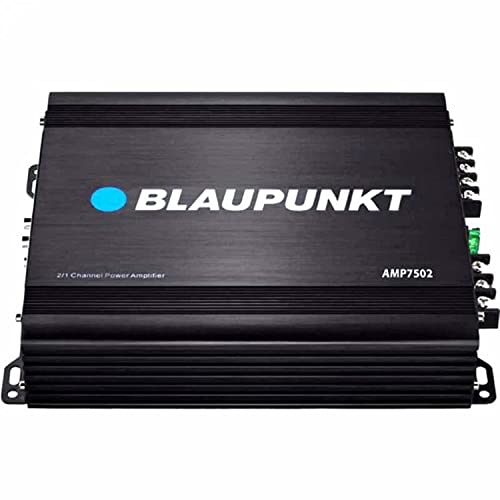
BLAUPUNKT 750W 2-Channel, Full-Range Amplifier (AMP7502)
Included for 'Best Amplifiers Under: How to Choose' because the listing specifies Full-Range Amplifier (AMP7502), details this guide uses to compare options.
View on Amazon
Taramps BASS 400 2 Ohms 400W RMS Monoblock Subwoofer Car Audio Amplifier
Included for 'Best Amplifiers Under: How to Choose' as a relevant option in this category; details come from the product listing.
View on AmazonExpect roughly 30–100 watts per channel on specifications, but treat maximum figures cautiously. Actual output depends on the power supply, distortion level, and whether both channels are driven. These amplifiers work best with speakers rated at 6 or 8 ohms and with sensitivity around 86 dB or higher.
Choose this range when you already have passive speakers and want a simple system. It is less suitable for a turntable without a built-in phono preamp, several wired sources, or a home-theater setup. A compact amplifier may also have limited cooling, so leave at least 2 inches of open space above it and avoid placing it inside a tightly closed cabinet.
Under $350: the practical first stereo system
This range is a strong choice for a living-room system built around bookshelf speakers. The Yamaha A-S301 is a well-known example of an entry-level integrated amplifier with conventional stereo design, a built-in phono input, digital inputs, and enough power for many medium-sized rooms. The exact market price varies, but comparable integrated amplifiers usually cost $250–$400.
Look for approximately 50–70 watts per channel into 8 ohms, a real volume control, a remote, and a dedicated subwoofer output. A power rating in this area is usually more useful than an inexpensive amplifier claiming several hundred watts from a tiny power brick.
For a 12-by-15-foot room, this range can comfortably drive bookshelf speakers to normal listening levels. If you sit more than 12 feet from the speakers, listen at concert-like volume, or use low-sensitivity speakers below about 84 dB, consider moving up a price range rather than relying on the wattage printed on the box.
Under $600: flexible stereo for music and television
Amplifiers in the $350–$600 range are often the best balance of price, connectivity, and long-term usefulness. The Cambridge Audio AXA35 and Denon PMA-600NE are examples of integrated stereo amplifiers in or near this category, depending on promotions and regional pricing.
These models typically add better input selection, a phono stage for a turntable, optical or coaxial digital inputs, Bluetooth, and a headphone connection. The Denon PMA-600NE is particularly useful when a television, phone, turntable, and CD player all need to share one system. The Cambridge Audio AXA35 emphasizes straightforward stereo operation and includes a moving-magnet phono input.
For a 10-by-12-foot or 12-by-15-foot room, 40–70 clean watts per channel is generally sufficient with ordinary bookshelf speakers. In a larger 18-by-20-foot room, look for closer to 80–100 watts per channel, especially if the speakers are rated at 6 ohms or lower.
Under $1,000: streaming amplifiers that reduce clutter
If the goal is one compact device for music, television, and everyday streaming, a network amplifier is often a better purchase than a traditional amplifier plus separate components. The WiiM Amp is a notable example, combining network streaming, room-adjustment tools, Bluetooth, HDMI ARC for a television, and speaker outputs in a compact enclosure. Similar network amplifiers generally cost $400–$1,000.
Its main advantage is convenience: the television can use HDMI ARC, music can stream over Wi-Fi, and a powered subwoofer can extend bass without adding a separate preamp. Check the manufacturer’s power specification carefully, because output figures may be measured at different impedances and distortion levels.
Network amplifiers are a strong choice for apartments and multipurpose rooms. They are less ideal if you want many physical inputs, a full-size front panel, or a traditional system that will remain usable if a streaming service changes. For long-term flexibility, confirm that the amplifier still includes at least one or two analog inputs.
Under $1,500: home theater versus stereo
Do not confuse a stereo integrated amplifier with an AV receiver. A stereo amplifier powers two speakers, while a home-theater receiver or processor-and-amplifier system handles multiple channels, HDMI video, surround formats, and speaker calibration.
For a television with a pair of quality front speakers, a stereo network amplifier with HDMI ARC may be enough. For a center speaker, surround speakers, and multiple game consoles, choose an AV receiver instead. The Marantz Cinema 70s is a slim AV receiver example for buyers who need surround processing but have limited cabinet space; conventional 7-channel AV receivers often offer more power and cooling for similar money.
In a medium room, a 5.1 or 7.1 receiver paired with a powered subwoofer can deliver better movie impact than spending the entire budget on a powerful two-channel amplifier. A subwoofer handles the most demanding low frequencies, leaving the main amplifier with less work.
How to match an amplifier to your speakers
1. Check impedance and sensitivity
Speaker impedance is measured in ohms. Most home speakers are nominally 6 or 8 ohms, but their impedance can dip lower at certain frequencies. Confirm that the amplifier is rated for the speaker’s impedance, particularly if you plan to use two pairs of speakers at once.
Sensitivity indicates how loudly a speaker plays from a given amount of power. A speaker rated at 90 dB is easier to drive than one rated at 84 dB. Every 3 dB increase in sensitivity roughly doubles acoustic output for the same amplifier power, so a modest amplifier can outperform a more powerful one when paired with efficient speakers.
2. Estimate room size and listening distance
For a small 10-by-12-foot room, 30–50 clean watts per channel is often enough. A 12-by-15-foot living room generally benefits from 50–80 watts, while a large open-plan room may need more power, more sensitive speakers, or a subwoofer.
Place the speakers at least 12–24 inches from the back wall when possible, and leave around 2–3 feet between each speaker for a stable stereo image. Do not put an amplifier directly on carpet or stack it beneath a hot receiver. Allow roughly 2 inches above the case and 1 inch on each side for ventilation unless the manual specifies more.
3. Count inputs before buying
- Turntable: requires a phono input or a separate phono preamp.
- Television: HDMI ARC is usually more convenient than optical because it can allow volume control from the TV remote.
- CD player: needs an analog RCA, optical, or coaxial digital input.
- Phone: Bluetooth is simple; Wi-Fi streaming usually offers better range and multi-room options.
- Subwoofer: look for a dedicated subwoofer output or a high-level input on the subwoofer.
Decision guide by situation
| Your situation | Best amplifier type | Why |
|---|---|---|
| Small apartment or bedroom | Compact Class D or network amplifier | Low heat, small footprint, enough power for bookshelf speakers |
| Kids or pets near the equipment | Enclosed integrated amplifier with a remote | Fewer exposed controls and simpler cable management |
| Renter who may move | Network amplifier with HDMI ARC and Bluetooth | One flexible unit works with different room layouts and televisions |
| Turntable and vinyl collection | Integrated amplifier with a moving-magnet phono input | Avoids the cost and shelf space of a separate phono stage |
| Movies with surround sound | AV receiver rather than stereo amplifier | Provides multiple channels, HDMI switching, and surround decoding |
| Large room or difficult speakers | Higher-current integrated amplifier or AV receiver with subwoofer | Provides more headroom and reduces strain at higher volume |
Installation and durability details people often miss
Amplifiers are heavier than their dimensions suggest. A conventional integrated amplifier may weigh 15–25 pounds, while an AV receiver can weigh 20–35 pounds. Check that the furniture shelf can support the weight without sagging and that the shelf is at least 2 inches wider than the amplifier on each side.
Measure doorways and stair turns before purchasing a large speaker-and-amplifier system. A boxed AV receiver may need 4–6 inches of additional clearance beyond the product’s listed width and depth. Keep speaker cables away from walking paths, and use strain relief so a child or pet cannot pull the amplifier from the shelf.
The components most likely to show wear are remote-control buttons, input switches, cooling fans, and cheaply made speaker terminals. A metal chassis, accessible ventilation, a replaceable power cord, and a standard remote are practical durability advantages. Spending more for power is worthwhile only when it solves a real problem: low-sensitivity speakers, a larger room, more inputs, or the need for surround sound.
Final buying recommendation
For the best amplifiers under $150, choose a compact Class D model for an efficient bookshelf-speaker system. Around $300–$600, an integrated stereo amplifier is the safest all-purpose purchase for music, turntables, and television. Around $500–$1,000, a network amplifier offers the cleanest setup and the most everyday convenience. If your priority is surround sound, skip stereo models and buy an AV receiver with the required HDMI inputs and channels.