Key takeaways
- The best balance ball chairs combine a correctly sized exercise ball with a stable frame, adjustable or suitable desk height, and a washable cover—so the right choice depends more on your body measurements and sitting habits than on the chair’s…
The best balance ball chairs combine a correctly sized exercise ball with a stable frame, adjustable or suitable desk height, and a washable cover—so the right choice depends more on your body measurements and sitting habits than on the chair’s appearance.
Quick picks by sitting situation
| Situation | Best choice | Why it fits |
|---|---|---|
| Small apartment or shared office | Compact ball-chair frame with casters | Usually needs about 24–28 inches of storage width and can be moved under a desk |
| Long desk sessions | High-back frame with a 55–65 cm ball and adjustable height | Offers more support and a better chance of matching a standard desk |
| Renters or frequent movers | Lightweight, collapsible frame with a removable cover | Fewer bulky parts and easier transport through narrow doorways |
| Children or pets at home | Anti-burst ball inside a zippered, washable cover | Reduces puncture risk and makes dirt, fur, and spills easier to manage |
| Back discomfort | Ball chair with a supportive backrest and adjustable seat height | Allows active movement without requiring unsupported balance all day |
What makes the best balance ball chairs different?
A balance ball chair is not simply an exercise ball placed beneath a desk. The frame should prevent the ball from rolling away while still allowing small movements through the pelvis and trunk. A useful design has a broad base, a retaining ring or cradle, stable feet or locking casters, and a seat position that keeps your knees slightly lower than your hips.

Gaiam Classic Balance Ball Chair, Stability Seat (Black)
Included for 'Best Balance Ball Chairs for Active Sitting' because the listing specifies Stability Seat (Black), details this guide uses to compare options.
View on Amazon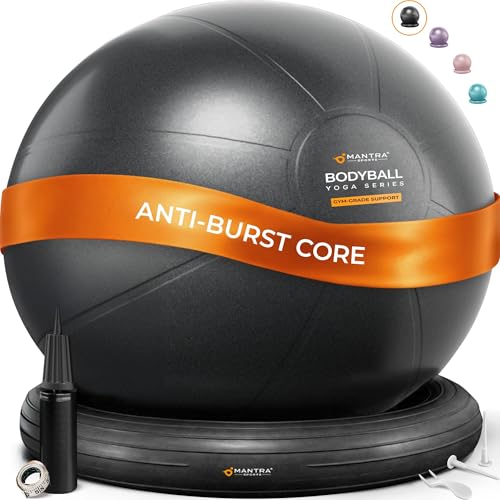
MANTRA SPORTS Yoga Ball Chair for Office Desk with Base - Ergonomic Balance & Stability Exercise Ball Seat for Adults - Active Sitting for Posture, Core & Back Pain Relief, Home Gym, Therapy, Pump
Included for 'Best Balance Ball Chairs for Active Sitting' because the listing specifies Ergonomic Balance & Stability Exercise Ball Seat for Adults and Active Sitting for Posture, details this guide uses to compare options.
View on Amazon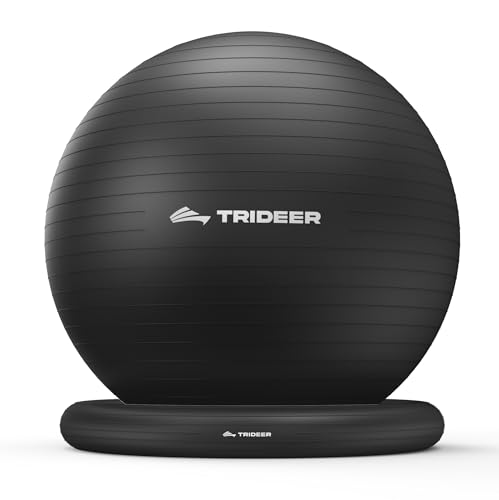
Trideer Exercise Ball Chair – Yoga Ball Chair for Office, Pregnancy & Home
Included for 'Best Balance Ball Chairs for Active Sitting' because the listing specifies Yoga Ball Chair for Office and Pregnancy & Home, details this guide uses to compare options.
View on Amazon
Aeromat Elite Yoga Ball Chair Active Sitting & Adjustable Height 250lbs Cap
Included for 'Best Balance Ball Chairs for Active Sitting' as a relevant option in this category; details come from the product listing.
View on AmazonLook for a ball labeled anti-burst rather than merely “burst-resistant.” Most quality fitness balls use thick PVC designed to deflate gradually if punctured, but the exact weight rating varies. The frame itself also has a limit. When comparing products, use the lower of the ball’s rated capacity and the frame’s rated capacity, and leave a safety margin if you lean back, shift quickly, or use the chair for stretching.
Choose the ball size before choosing the upholstery
Ball diameter affects both comfort and desk alignment. The most common office sizes are 55 cm, 65 cm, and 75 cm, but the chair frame, inflation level, and your body proportions can change the final seat height by several inches.
| Ball diameter | Typical user height | Approximate seat height in a frame | Best use |
|---|---|---|---|
| 45–55 cm | Under about 5 ft 4 in | 17–21 in | Children, shorter adults, compact desks |
| 55–65 cm | About 5 ft 4 in to 6 ft | 20–25 in | Most standard home desks |
| 65–75 cm | About 6 ft and taller | 23–29 in | Tall users and higher work surfaces |
These are starting ranges, not guarantees. Measure from the floor to the underside of your desk, then compare that space with the chair’s lowest and highest settings. A typical fixed desk is about 28–30 inches high, while many height-adjustable desks can be set lower. Your goal is to work with relaxed shoulders, elbows near 90 degrees, and feet flat on the floor. If the ball is too large, you may raise your shoulders to reach the keyboard; if it is too small, your knees may rise above your hips.
Measure the desk and the room
Before ordering, measure three clearances: the underside of the desk, the space between desk legs, and the distance behind the chair. Allow at least 24 inches of width for the chair itself and preferably 30 inches if you want to roll out easily. Leave 30–36 inches behind the chair for comfortable movement; 36–42 inches is better if someone needs to pass behind you.
In a 10-by-12-foot room, a ball chair can work well at a 48–60-inch desk, provided the desk is against a wall and the chair can be pushed in fully. A chair with a fixed rear stabilizer or wide five-star base may require more clearance than its published width suggests. Check whether the frame’s rear bar or casters project beyond the ball when the chair is pulled away from the desk.
Doorways matter when moving the chair. A deflated ball is easy to carry, but an assembled frame may not fit through a 28-inch doorway if its arms, backrest, or wheelbase are wide. Prefer models that separate into a base, back, and seat support if you move frequently.
Frame stability versus freedom of movement
A low cradle or retaining ring gives the most reassuring feel for beginners and makes it harder to roll away while standing. A taller frame with a backrest is usually more practical for computer work, but it can feel less active because the back encourages you to lean. Casters improve portability, yet unlocked wheels can make reaching or sitting down less stable. Locking casters are the better compromise for a work chair.
Do not confuse movement with instability. The ball should permit small posture changes without the frame rocking, sliding, or tipping. A wide metal base generally provides the best strength-to-size ratio. Molded plastic can be lighter and less expensive, but inspect the joints, retaining ring, and caster mounts carefully, especially if the chair will be used every day.
Material trade-offs that affect daily use
| Component | Common material | Advantages | Trade-offs |
|---|---|---|---|
| Frame | Powder-coated steel | Strong, rigid, and usually suitable for heavier daily use | Heavier; exposed edges and welds need inspection |
| Frame | Reinforced plastic | Lightweight, easier to move, often quieter on hard floors | Can flex or crack if overloaded or exposed to heat |
| Ball | Thick PVC | Easy to clean and commonly available in replacement sizes | Can lose air over time and should be kept away from sharp objects |
| Cover | Polyester or nylon | Durable, inexpensive, and often machine washable | May feel warm and can collect pet hair |
| Cover | Wool-blend or textured fabric | More comfortable in changing temperatures | Usually harder to clean and may show wear at contact points |
The cover’s zipper is often one of the first parts to fail, followed by stretched seams, worn caster wheels, and a ball that slowly loses pressure. A removable cover is worth p