Key takeaways
- Steel mesh: lightweight, inexpensive, and you can see what is inside. The mesh openings can snag the corner of thin paper when you slide sheets in, and dust passes through to whatever sits below.
- Solid sheet steel: heavier and quieter, gives a cleaner office look, and pages slide in smoothly. Hides clutter but also hides forgotten paperwork.
- Bent wire: the most minimal style. Works well for vertical sorters but is a poor surface for loose single sheets, which can droop between the wires.
The best metal paper holder for a desk depends on what the paper is doing: stacking letter trays suit paper you process in batches, a vertical file sorter suits folders you grab daily, and an upright document copy holder suits pages you read while typing. Metal, usually powder-coated steel mesh or solid sheet steel, is worth choosing over plastic because it does not bow under a ream, it resists cracking, and it stays put on the desk. The rest comes down to footprint, capacity and how you actually work.
Match the holder to the paper’s job
| Holder type | Typical footprint | Practical capacity | Best for |
|---|---|---|---|
| Single letter tray | about 10 x 13 in | 200–300 sheets | Inbox or printer output |
| Stacking trays (2–3 tiers) | about 10 x 13 in, 7–12 in tall | 200–300 sheets per tier | Inbox / pending / done workflow |
| Vertical file sorter (3–6 slots) | about 6–12 x 10 in | 3–6 file folders or 10–20 folders total | Active projects you reach for often |
| Step file / incline sorter | about 10–13 x 10 in | 5–6 tiers of folders | Seeing every folder tab at a glance |
| Document copy holder (easel or in-line) | about 4–12 in deep, 10–14 in tall | 1–30 pages open | Typing from printed source material |
| Wall or panel pocket | 0 in of desk space | 1 inch of paper per pocket | Small desks; cubicle panels |
Steel mesh vs solid steel vs wire
Most metal desk paper holders come in three constructions, and each behaves a bit differently.

Simple Houseware Stackable Letter Tray Organizer, 3-Pack, Black
Included for 'Metal Paper Holder for Desk: Trays, Sorters and Copy Holders by How You Work' because the listing specifies 3-Pack and Black, details this guide uses to compare options.
View on Amazon
Simple Houseware Stackable Letter Tray, Wire Grid, Black
Included for 'Metal Paper Holder for Desk: Trays, Sorters and Copy Holders by How You Work' because the listing specifies Wire Grid and Black, details this guide uses to compare options.
View on Amazon
Simple Houseware Stackable Letter Tray Organizer, 3-Pack, Silver
Included for 'Metal Paper Holder for Desk: Trays, Sorters and Copy Holders by How You Work' because the listing specifies 3-Pack and Silver, details this guide uses to compare options.
View on Amazon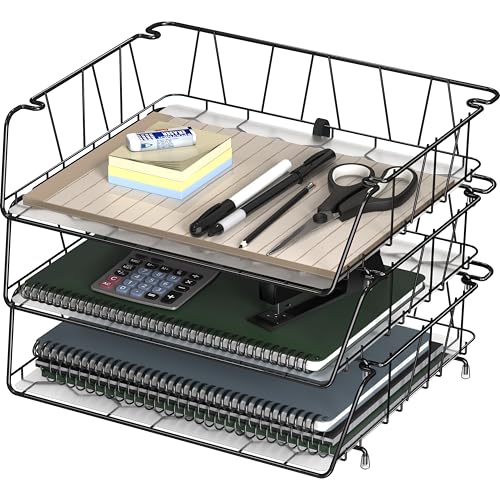
Simple Houseware Stackable Wide Entry Letter Tray, Wire Grid, Black
Included for 'Metal Paper Holder for Desk: Trays, Sorters and Copy Holders by How You Work' because the listing specifies Wire Grid and Black, details this guide uses to compare options.
View on Amazon- Steel mesh: lightweight, inexpensive, and you can see what is inside. The mesh openings can snag the corner of thin paper when you slide sheets in, and dust passes through to whatever sits below.
- Solid sheet steel: heavier and quieter, gives a cleaner office look, and pages slide in smoothly. Hides clutter but also hides forgotten paperwork.
- Bent wire: the most minimal style. Works well for vertical sorters but is a poor surface for loose single sheets, which can droop between the wires.
Powder coating is the norm in black, white, silver and gold tones. It handles everyday wear well, but chips where trays are stacked and unstacked repeatedly. Felt or rubber feet are worth having; bare metal feet can scratch a wood or laminate desktop.
Size details that trip people up
Trays are sized for either US letter (8.5 x 11 in) or legal (8.5 x 14 in). A letter tray will not hold legal sheets flat, and a legal tray takes about 3 in more desk depth. If you handle A4 paper (8.27 x 11.69 in), a letter tray is often too short; choose one with at least 12 in interior length.
For stacking trays, the gap between tiers decides capacity. Risers of 2–2.5 in fit about 200–250 sheets of standard 20 lb paper per tier; 3–4 in risers take thicker folders. A ream of 500 sheets is about 2 in thick, which is a handy benchmark.
Vertical sorters are measured by slot width. Slots narrower than about 1.5 in fit one or two hanging-style manila folders; slots of 2–3 in take binders or thicker project folders.
Document holders for typing comfort
If the goal is reading pages while you type, a copy holder is the right kind of paper holder and placement matters more than material.
- In-line holders sit between the keyboard and monitor at an angle, so your eyes move straight up and down. They need roughly 4–8 in of free depth in front of the screen.
- Easel or side holders sit beside the monitor at the same distance and height as the screen, so your neck turns but does not tilt.
- Arm-mounted holders clamp to the desk edge and swing into view; useful when desk space is tight.
Look for a line guide or magnetic ruler if you transcribe numbers, and a ledge at least 1 in deep if you open a thick booklet on it.
Which one fits your desk
| Desk situation | Pick | Why |
|---|---|---|
| Small desk, under 40 in wide | Vertical sorter or wall pocket | Uses height instead of depth |
| Lots of incoming mail and bills | Two-tier stacking trays | Simple “to do” and “done” system |
| Several active projects | Step file with 5–6 tiers | Every tab visible, easy to grab |
| Data entry or transcription | In-line or easel copy holder | Reduces head turning while typing |
| Shared or front-desk area | Solid steel trays | Looks tidier and hides contents |
| Standing desk that moves often | Weighted solid steel or rubber-footed sorter | Light mesh can slide when the desk rises |
Pricing and what you get
Metal mesh letter trays and small sorters usually cost about $10–$30. Solid steel stacking sets and multi-tier step files commonly run $25–$60. Heavier designer pieces in brass-tone or wood-and-steel combinations can go over $80, and you are largely paying for finish. Adjustable copy holders with arms are often $25–$70.
Common mistakes and wear
- Stacking too high: three-tier trays over about 12 in tall get knocked over and block the view of a monitor on a shallow desk.
- Overfilling sorters: a packed vertical sorter tips forward when you pull one folder; leave about 20 percent free space in each slot.
- Ignoring the riser fit: some stacking trays use separate posts that loosen over time. One-piece welded designs stay square longer.
- Mesh snagging: slide paper in short-edge first, or add a thin card at the bottom of each tray.
Maintenance is simple: wipe with a damp cloth, avoid abrasive cleaners on powder coat, and touch up chips with matching enamel to stop rust in humid rooms.
Bottom line
Pick a stacking tray if paper arrives and leaves in batches, a vertical or step sorter if you work from folders, and a copy holder if you read while you type. Choose steel for rigidity, confirm the tray fits your paper size, and size the tiers to the stack you really keep on hand rather than the most you might ever have.