Key takeaways
- Safety listing: any built-in AC outlet should carry a UL or ETL mark. Unlisted strips are the main risk with budget desks.
- Surge protection: many desk strips are simple outlets with no surge protection. Plug your PC and monitor into a proper surge protector instead, and use the desk strip for chargers.
- Cord length: desk strips often come with a 4- to 6-foot cord. Measure from the desk edge to the nearest outlet, running down the leg and along the wall.
- Placement: edge-mounted strips on the right or left side suit whichever hand you use less. A strip in the middle back of the desk means reaching over the monitor.
- Replaceable module: check if the USB strip is screwed on (replaceable) or molded into the frame. Ports are the part most likely to fail, so a replaceable module extends the desk’s life.
A gaming desk with USB ports has a built-in power strip or hub. Most handle phone and controller charging well, but very few can replace a proper USB hub for data, and almost none can fast-charge a laptop. Before you pay extra for one, check whether its ports are charging-only or data-capable, and look at the wattage of any USB-C port. Those two details decide whether the feature is useful or just decoration.
The three kinds of “USB ports” on gaming desks
Product listings usually just say “with USB ports.” In reality, desks use one of three setups, and they do very different jobs.

ODK 53" L Shaped Gaming Desk with Shelves, LED & Outlets, Black
Included for 'Gaming Desk With USB Ports: What the Built-In Ports Can Really Charge and Connect' because the listing specifies LED & Outlets and Black, details this guide uses to compare options.
View on Amazon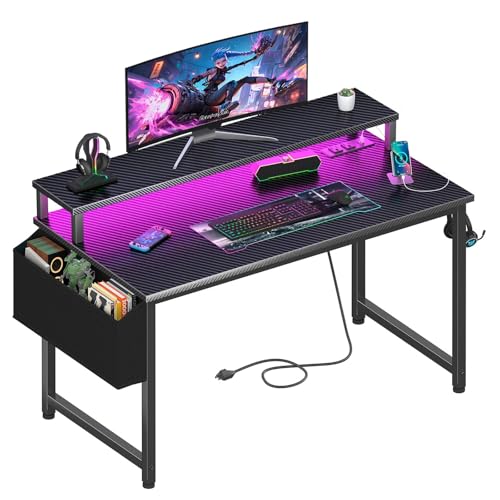
Lufeiya Gaming Desk with Power Outlets and LED Lights, 40 Inch Gamer Desk Table with Charging Station, Home Office Computer Desks with Monitor, Black
Included for 'Gaming Desk With USB Ports: What the Built-In Ports Can Really Charge and Connect' because the listing specifies 40 Inch Gamer Desk Table with Charging Station and Home Office Computer Desks with Monitor, details this guide uses to compare options.
View on Amazon
Korfile 48" Gaming Desk with Power Outlet, LED, Carbon Fiber Black Finish
Included for 'Gaming Desk With USB Ports: What the Built-In Ports Can Really Charge and Connect' because the listing specifies LED and Carbon Fiber Black Finish, details this guide uses to compare options.
View on Amazon
Unikito Reversible L Shaped Desk with Magic Power Outlets and USB Charging Ports, Sturdy Corner Computer Desk with Storage Shelves, Gaming Table Home Office Desk, Easy to Assemble, Black
Included for 'Gaming Desk With USB Ports: What the Built-In Ports Can Really Charge and Connect' because the listing specifies Sturdy Corner Computer Desk with Storage Shelves and Gaming Table Home Office Desk, details this guide uses to compare options.
View on Amazon1. Charging-only power strip
This is the most common type. A strip mounted on the desk edge or in a grommet plugs into the wall and offers two or three AC outlets plus two to four USB ports. The USB ports carry power but no data. They’re good for phones, controllers, earbuds and a headset dock. They won’t connect a keyboard, mouse or webcam to your PC.
2. Pass-through data hub
The desk has a small hub with a cable you plug into your PC. It works like any USB hub. A flash drive or a wired controller plugged into the desk shows up on the computer. Check the version: USB 2.0 hubs are limited to 480 Mbps, while USB 3.x hubs run at 5 Gbps or more. Most data hubs are unpowered. That means they share the PC port’s power budget, which is not enough for multiple power-hungry devices.
3. Combined power-and-data module
This is less common and usually found on higher-end desks. It’s a mains-powered unit with AC outlets, charging ports and a separate set of data ports. It’s the most capable option, and the most likely to need replacing as a whole if one part fails.
What the ports can actually power
| Port type | Typical output | Good for | Not enough for |
|---|---|---|---|
| USB-A 2.0 (data) | 5 V, 0.5 A (2.5 W) | Mouse, keyboard, wireless dongle | Charging a phone at a useful speed |
| USB-A 3.x (data) | 5 V, 0.9 A (4.5 W) | Flash drive, webcam, headset | Portable SSD plus other devices on an unpowered hub |
| USB-A charging | 5 V, 2.1 – 2.4 A (10 – 12 W) | Phones, controllers, earbuds | Tablets in a hurry, laptops |
| USB-C charging (basic) | 15 – 20 W | Fast-charging most phones | Laptops beyond trickle charge |
| USB-C PD (higher end) | 30 – 65 W | Handheld consoles, tablets, thin laptops | Gaming laptops (often 140 W+ via their own brick) |
Another catch is that total output is often shared. A strip advertising “four USB ports, 3.1 A” means 3.1 amps split across all four. That’s about 15 watts total, so two phones charging at once will each charge slower.
Checklist before you buy
- Safety listing: any built-in AC outlet should carry a UL or ETL mark. Unlisted strips are the main risk with budget desks.
- Surge protection: many desk strips are simple outlets with no surge protection. Plug your PC and monitor into a proper surge protector instead, and use the desk strip for chargers.
- Cord length: desk strips often come with a 4- to 6-foot cord. Measure from the desk edge to the nearest outlet, running down the leg and along the wall.
- Placement: edge-mounted strips on the right or left side suit whichever hand you use less. A strip in the middle back of the desk means reaching over the monitor.
- Replaceable module: check if the USB strip is screwed on (replaceable) or molded into the frame. Ports are the part most likely to fail, so a replaceable module extends the desk’s life.
Gaming desk sizing still matters more
Ports are the extra. The desk still has to fit your setup:
| Setup | Minimum width | Recommended depth | Notes |
|---|---|---|---|
| Single 24 – 27 in monitor | 40 – 47 in | 24 in | Room for a full-size mouse pad |
| Single 32 – 34 in ultrawide | 55 in | 27 – 30 in | Keeps the screen 28 in or more from your eyes |
| Dual 27 in monitors | 55 – 60 in | 27 in | Monitor arm saves 8 – 10 in of depth |
| Triple monitors or sim rig | 63 in+ or L-shape | 30 in | Check leg spacing for a wheel stand |
Fixed gaming desks are usually 29 to 30 inches tall. If you’re under about 5 ft 7 in, plan for a chair you can raise and a footrest, or look at a height-adjustable frame. Many standing-desk frames now offer a clip-on USB module, which gives you the same convenience with better ergonomics.
Frame and top construction
Gaming desks with ports are usually steel frames with a laminated particleboard or MDF top, 0.6 to 1 inch thick. Carbon-fiber-texture laminate is a printed finish, not real carbon fiber. It hides scuffs well but chips at the edges. Static weight limits typically run 110 to 220 lb, which easily covers monitors and a PC. Monitor-arm clamps need a top at least 0.6 inches thick and a solid edge. Avoid clamping over the cable grommet.
Box weights typically range from 40 to 90 lb, with 30 to 60 minutes of assembly for a simple Z- or K-frame. Budget desks with built-in power strips commonly cost $100 to $250. Steel-frame desks with better USB-C power modules and larger tops cost $250 to $500.
Which setup makes sense for you
| If you mainly want to… | Choose |
|---|---|
| Charge a phone and controllers without crawling under the desk | Desk with a charging strip; USB-A is fine |
| Fast-charge a phone or handheld console | Look for at least one USB-C port rated 20 W or higher |
| Plug in flash drives and peripherals easily | Data hub at USB 3.x, or add a separate powered hub |
| Power a laptop from the desk | Skip desk ports; use the laptop charger or a dedicated 65 W+ charger |
| Keep the desk for many years | Plain desk plus a quality clamp-on power strip you can replace |
Bottom line
Built-in USB ports on a gaming desk are a convenience for charging small devices. Treat them that way. If you need fast USB-C charging or real data ports, read the wattage and USB version carefully, or buy a desk you love and add a separately rated clamp-on hub. That way you can upgrade the electronics without replacing the furniture.