Key takeaways
- Lift geometry over raw size: Measure lid height at the front edge. Anything above roughly 30 inches forces an overhead reach; anything below 18 inches means a deep hip hinge every time you load cushions. Mid-height boxes with a hydraulic or friction lid stay are easiest on shoulders and lower back.
- Reach depth versus arm span: A box deeper than about 24 inches front-to-back requires leaning your torso inside. Wide-and-shallow beats narrow-and-deep for daily cushion handling, even at identical gallon ratings.
- Wall rigidity and rib structure: Press the middle of a side panel. Flex means the resin is thin, and thin resin bows permanently once it’s sun-heated and packed full. Look for internal ribbing and double-wall corners.
- Hinge and fastener metallurgy: Hinges are the first failure point. Stainless or coated steel pins with metal-reinforced hinge plates outlast molded plastic knuckles by years, especially in coastal salt air.
- Drainage and floor clearance: Cushions rot from below. Elevated or ribbed floors, weather-lipped lids, and a raised base that keeps the panel off standing water matter more than any advertised “waterproof” claim.
What's inside
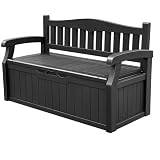
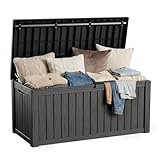
The Devoko 100 Gallon Waterproof Resin Deck Box is the best overall deck box for cushion storage, with the PatioZen 200 Gallon Lockable Deck Box as the runner-up. The Devoko wins on the two things that actually determine a deck box’s lifespan: a lid you can open one-handed without bending at the lumbar spine, and resin panels that resist the summer-long UV creep that turns cheap boxes into sagging parallelograms.
Most buyers shop deck boxes by gallon capacity alone, then discover the real problems in month three — a lid that slams on your forearm, a hinge that shears off in the first windstorm, a floor that wicks moisture into the bottom cushion, or a footprint that forces you to kneel on wet decking to reach the back corner. This guide evaluates six popular resin boxes through an ergonomics-and-durability lens: lift geometry, reach depth, hinge and fastener quality, wall rigidity, and how well each one keeps cushion foam dry through a full freeze-thaw cycle.
As an Amazon Associate we earn from qualifying purchases.





Quick Comparison
| Product | Best For | Standout Feature | Rating |
|---|---|---|---|
| Devoko 100 Gallon Resin Deck Box | Balanced everyday use | Shallow reach depth, easy one-handed lid | See rating above |
| PatioZen 200 Gallon Lockable Deck Box | Value on larger capacity | Lockable hasp with UV-resistant shell | See rating above |
| Flamaker 100 Gallon Resin Deck Box | Premium finish and rigidity | Textured panels with reinforced ribbing | See rating above |
| KFY 200 Gallon Outdoor Storage Box | Bench-height seating duty | Load-rated lid for double use | See rating above |
| TARKARI 320 Gallon Resin Storage Box | Full deep-seat cushion sets | Tall interior swallows back cushions upright | See rating above |
How to Choose a Deck Box for Cushion Storage
- Lift geometry over raw size: Measure lid height at the front edge. Anything above roughly 30 inches forces an overhead reach; anything below 18 inches means a deep hip hinge every time you load cushions. Mid-height boxes with a hydraulic or friction lid stay are easiest on shoulders and lower back.
- Reach depth versus arm span: A box deeper than about 24 inches front-to-back requires leaning your torso inside. Wide-and-shallow beats narrow-and-deep for daily cushion handling, even at identical gallon ratings.
- Wall rigidity and rib structure: Press the middle of a side panel. Flex means the resin is thin, and thin resin bows permanently once it’s sun-heated and packed full. Look for internal ribbing and double-wall corners.
- Hinge and fastener metallurgy: Hinges are the first failure point. Stainless or coated steel pins with metal-reinforced hinge plates outlast molded plastic knuckles by years, especially in coastal salt air.
- Drainage and floor clearance: Cushions rot from below. Elevated or ribbed floors, weather-lipped lids, and a raised base that keeps the panel off standing water matter more than any advertised “waterproof” claim.
The Best Deck Boxes for Cushion Storage Reviewed
Best Overall: Devoko 100 Gallon Waterproof Resin Deck Box
The Devoko hits the ergonomic sweet spot — a lid you can flip open with one hand while carrying cushions in the other, and a reach depth shallow enough that you’re not diving in headfirst. Best for homeowners storing a two-seat sofa’s cushions or a set of chair pads on a mid-size deck.
Best Budget: PatioZen 200 Gallon Lockable Deck Box
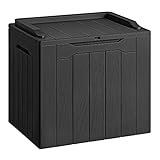
Twice the capacity of typical entry boxes without the entry-level compromises: a proper lockable hasp and a UV-stabilized black shell that resists chalking. Best for buyers who need bulk volume for umbrellas and cushions but won’t pay premium prices for it.
Best Premium: Flamaker 100 Gallon Resin Deck Box
The most rigid panels in this group, with a wicker-textured finish that hides scuffs and internal ribbing that keeps the walls plumb under load. Best for design-conscious patios where the box sits in plain view year-round.
Best for Double-Duty Seating: KFY 200 Gallon Outdoor Storage Box
The reinforced, load-rated lid means this one legitimately works as a bench, which is where most deck boxes crack. Best for small patios and balconies where storage and seating have to share the same footprint.
Best for Deep-Seat Cushion Sets: TARKARI 320 Gallon Resin Storage Box
Tall enough internally to stand thick back cushions upright rather than folding them — which is what prevents permanent foam compression over winter. Best for owners of full sectional or dining-set cushion collections.
Frequently Asked Questions
Are resin deck boxes truly waterproof?
Water-resistant is the accurate term. Weather-lipped lids and sealed seams shed rain well, but wind-driven moisture and condensation still occur. Store cushions dry, leave a small air gap, and check the interior after the first heavy storm.
How much capacity do I need for a cushion set?
Budget roughly 100 gallons for four chair cushions, 200 gallons for a loveseat or small sofa set, and 300 gallons or more for a sectional. The ASKPASS 360 Gallon Outdoor Storage Box covers the largest collections.
Should I anchor a deck box in high wind?
Yes. An empty resin box is light enough to tumble. Most models include anchor points or predrilled holes for deck screws or ground stakes — use them before hurricane or storm season.
Can I leave cushions inside all winter?
You can, provided they go in fully dry and the box has floor clearance. Stand cushions upright rather than stacking them flat to avoid foam compression set.
Final Thoughts
For most patios, the Devoko 100 Gallon delivers the best combination of easy lid access and panel rigidity, while the PatioZen 200 Gallon offers the strongest value if you need real bulk capacity with a lock. If you’re storing a full deep-seat sectional, step up to the TARKARI 320 Gallon and store those cushions upright — your foam will last several seasons longer.