Key takeaways
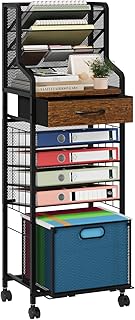
- Rolling file carts: Best for active, frequently accessed folders; wheels let you move the cart between desk and printer, like the Feyejade 6-tier or 3IngSeagulls 5-tier models.
- Collapsible file boxes: Ideal for archiving and moving; sets such as the Decorative File Organizer Box fold flat when empty.
- Literature organizers: Sorters like the VEVOR 12-compartment or Safco 36-compartment excel at mail, forms, and paper distribution.
- Book and supply bins: Interlocking bins such as the Storex 6-pack corral bulky items and supplies affordably.
Office storage sounds like a boring purchase until you are drowning in paper, cables, and supplies with nowhere to put them. The right storage system does more than hide clutter; it creates a workflow, keeping active files within reach, archiving what you rarely touch, and freeing your desktop for actual work. But the market is a maze of rolling carts, file boxes, literature sorters, and drawers, and buying the wrong type wastes both money and floor space.
This buying guide cuts through the confusion, explaining how to assess your needs and match them to the right solution, whether that is a mobile file cart, a collapsible file box, or a multi-compartment literature organizer. We reference proven 2026 options like the Feyejade 6-tier rolling cart and the VEVOR 12-compartment sorter so you can see how each format solves a specific storage problem.
Our top picks




As an Amazon Associate we earn from qualifying purchases at no extra cost to you. Ratings are shown as listed on Amazon.
⚡ Save on Your Next PC — Amazon Prime
Prime members get fast free shipping on the systems above, plus early access to Prime Day & Black Friday PC deals. New members get a 30-day free trial.
Watch: Buying Guide: Selecting the Right Office Storage Solutions — Video Review
Start by Auditing What You Store
Before buying anything, sort your stuff into three buckets: active items you use weekly, reference material you need occasionally, and archives you must keep but rarely open. Active files belong in accessible rolling carts, reference material suits open sorters, and archives can live in stackable boxes. This audit alone prevents the classic mistake of buying one bulky cabinet that serves none of these needs well.
Match the Format to the Job
- Rolling file carts: Best for active, frequently accessed folders; wheels let you move the cart between desk and printer, like the Feyejade 6-tier or 3IngSeagulls 5-tier models.
- Collapsible file boxes: Ideal for archiving and moving; sets such as the Decorative File Organizer Box fold flat when empty.
- Literature organizers: Sorters like the VEVOR 12-compartment or Safco 36-compartment excel at mail, forms, and paper distribution.
- Book and supply bins: Interlocking bins such as the Storex 6-pack corral bulky items and supplies affordably.
Consider Mobility and Footprint
Floor space is precious in a home office, so think vertical and mobile. A 6-tier rolling cart stores a lot in a narrow footprint and tucks under or beside a desk, while lockable wheels keep it steady when parked. If your space is fixed, a wall-adjacent literature sorter uses height rather than floor area. Measure your available nook before committing to a large unit.
Weigh Capacity Against Budget
Prices here span from a $23.79 Storex bin 6-pack to a $166 Safco 36-compartment sorter, and bigger is not always better. Buy capacity you will actually fill within a year; an oversized cabinet just invites clutter to expand. For most home offices, a mid-range rolling cart around $43-$57 plus a couple of file boxes covers active and archive needs without overspending.
Tips
- Label every drawer, box, and compartment so the system survives past the first tidy week.
- Keep only active files at desk height; store archives lower or in a closet to reserve prime space.
- Choose lockable wheels on any rolling cart you will lean on or load heavily.
- Standardize on one folder size so files transfer cleanly between carts, boxes, and drawers.
Frequently Asked Questions
What is the most versatile office storage solution?
A mobile rolling file cart, like the Feyejade 6-tier, is the most versatile because it stores active folders, moves where you need it, and fits narrow spaces beside a desk.
How do I store documents I rarely need?
Archive them in collapsible file boxes such as the Decorative File Organizer set. They keep paper protected, stack neatly, and fold flat when you finally clear the backlog.
Do I need a literature organizer?
Only if you handle a lot of incoming mail, forms, or distributed paper. For that, multi-compartment sorters like the VEVOR or Safco keep everything separated and findable.
How much should I budget?
Most home offices are well covered by a $43-$57 rolling cart plus one or two file boxes. Reserve larger $150-plus sorters for high-volume or shared workspaces.
Conclusion
Great office storage starts with an honest audit of active, reference, and archive material, then matches each to the right format: rolling carts for active files, boxes for archives, and sorters for mail. Options like the Feyejade cart, Decorative file boxes, and VEVOR sorter each solve a distinct problem, so buy for the job rather than the biggest cabinet. Label everything, keep active items in reach, and your office will stay organized long after the initial cleanup.